That Surprise Marzipan Layer: Why This Light Simnel Cake is Your New Easter Tradition
Let’s just get this out of the way: if you think you don’t like fruitcake, you probably haven’t had the right fruitcake. Forget those heavy, dense, neon-fruit-studded bricks you see at Christmas. This is different. This is Simnel cake, and it’s about to become your new Easter centerpiece.
What makes it so special? It’s a traditional British bake, but it’s much lighter than its winter cousin. The cake itself is moist, tender, and fragrant with warm spices like cinnamon and nutmeg. It’s studded with sweet, chewy raisins and currants.
But here is the real secret, the part that makes everyone’s eyes go wide: there is a whole disc of sweet, almond-rich marzipan baked right into the middle of the cake.
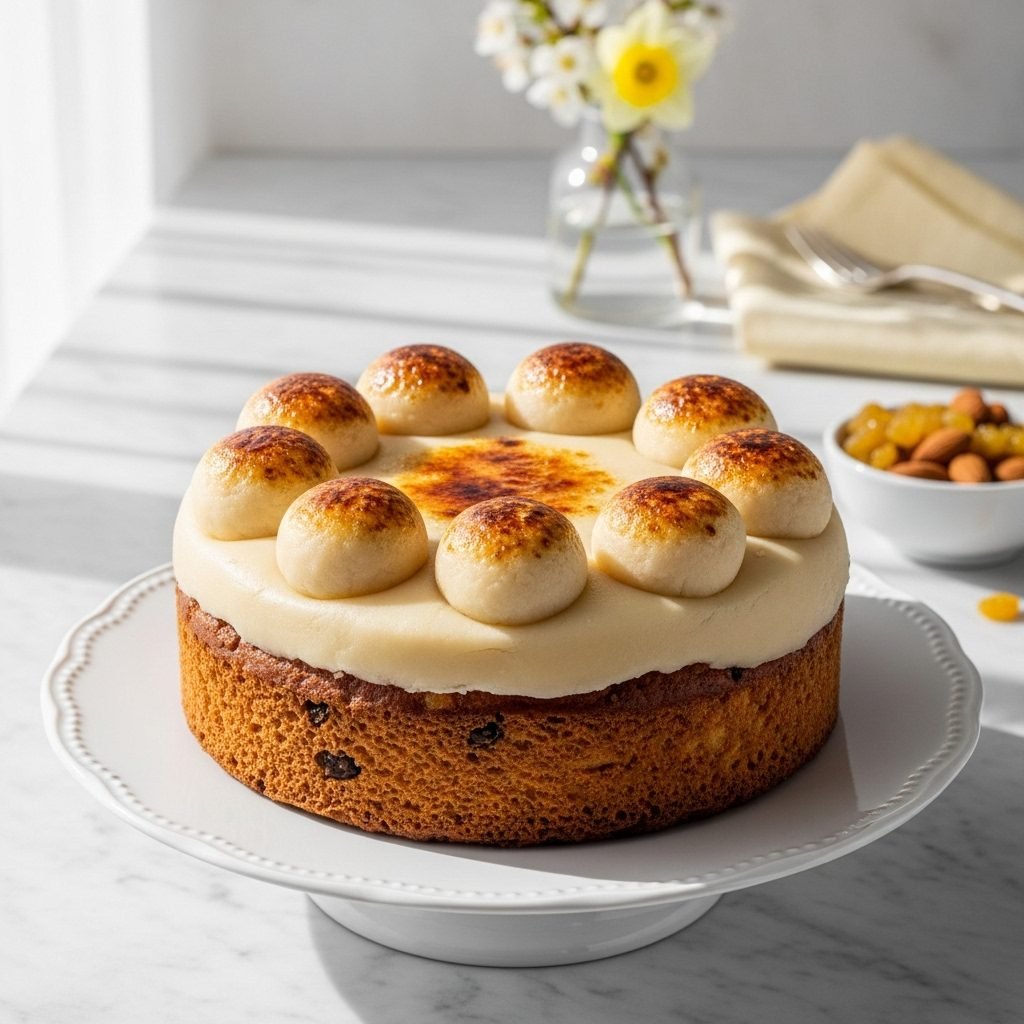
As it bakes, that marzipan layer melts just enough to infuse the cake around it with moisture and a subtle almond flavor. It’s incredible. Then, it’s topped with another layer of marzipan and decorated with 11 marzipan balls (a little nod to tradition that we’ll get into). The top is gently toasted under the broiler, giving it a caramelized, crème brûlée-like finish.
It looks so impressive on an Easter brunch table, and it tastes like pure, cozy tradition.
Why You’ll Fall for This Recipe
- The Flavor: This cake is a beautiful balance of warm spices, fruity raisins, and sweet, nutty almond. It’s rich but not heavy.
- The Texture: A moist, tender crumb meets the soft, slightly chewy marzipan. The toasted top adds a hint of crispness.
- Difficulty: I’d call this a “confident beginner” or “easy medium.” There are a few steps, but none are truly difficult. If you can roll out cookie dough, you can make this cake.
- That “Wow” Factor: The hidden marzipan layer is such a fun surprise, and the toasted top makes it look incredibly professional.
What You’ll Need for Your Simnel Cake
You’ll find most of this in your pantry already. The only special item is the marzipan, which is easily found in the baking aisle of most larger grocery stores (especially around the holidays) or online.
For the Cake Batter:
- 1 ½ cups (190g) all-purpose flour
- 1 ½ tsp baking powder
- 1 tsp ground cinnamon
- ½ tsp ground nutmeg
- ¼ tsp ground ginger
- ¼ tsp salt
- ¾ cup (1 ½ sticks or 170g) unsalted butter, softened to room temperature
- ¾ cup (165g) packed light brown sugar
- 3 large eggs, at room temperature
- 1 tsp almond extract (don’t skip this!)
- 1 tbsp milk
- 1 lb (about 3 cups) mixed dried fruit (I use a mix of golden raisins, regular raisins, and currants)
- Zest of 1 large lemon
- Zest of 1 large orange
For the Marzipan & Topping:
- 1 lb (454g) marzipan (store-bought is perfectly fine)
- A little powdered sugar, for dusting
- ⅓ cup apricot jam
Let’s Bake This Easter Tradition
Set aside a couple of hours for this. The process is relaxing, and your kitchen will smell incredible.
Step 1: Prep Your Pan and Fruit
- Preheat your oven to 300°F (150°C). This low-and-slow bake is key for a moist fruitcake.
- Grease an 8-inch round cake pan (at least 3 inches deep is ideal) and line the bottom and sides with parchment paper. This is non-negotiable! It prevents the sugary fruit from sticking and burning. I like to cut a circle for the bottom and a long strip for the sides.
- In a medium bowl, mix your dried fruit with the lemon and orange zests. Set it aside.
Step 2: Prepare the Marzipan
- Your 1 lb block of marzipan needs to be divided. Cut off about one-third (approx. 5.3 oz) and set it aside for the little balls later.
- Divide the remaining two-thirds block in half. You’ll have two equal pieces.
- Lightly dust your counter with powdered sugar (this stops it from sticking, just like flour for dough). Roll one of the pieces into an 8-inch circle. Use your 8-inch cake pan as a template—just place it over the marzipan and trim around it with a knife.
- Set this disc aside (I slide it onto a piece of parchment) and roll the second piece into another 8-inch circle. Set this one aside, too. You now have two 8-inch marzipan discs and one lump for the balls.
Step 3: Make the Cake Batter
- In a large bowl, whisk together the all-purpose flour, baking powder, cinnamon, nutmeg, ginger, and salt.
- In a separate, very large bowl (or the bowl of a stand mixer), cream the softened butter and light brown sugar together on medium speed until the mixture is light, fluffy, and pale. This takes about 3-5 minutes and whips air into your cake.
- Add the room-temperature eggs, one at a time, beating well after each addition. If the batter looks like it’s curdling or separating, don’t worry. Just add a tablespoon of your flour mixture and mix it in.
- Beat in the almond extract and the tablespoon of milk.
- Turn the mixer to low and add the flour mixture in two batches, mixing just until the flour streaks disappear. Do not overmix!
- Using a spatula, gently fold in the dried fruit and zest mixture. The batter will be thick and substantial.
Step 4: Assemble the Cake
- Spoon half of the thick batter into your prepared parchment-lined pan. Use the back of a spoon to spread it evenly.
- Gently place one of your 8-inch marzipan discs on top of the batter. Press it down very lightly. This is your magic hidden layer!
- Spoon the remaining half of the cake batter on top of the marzipan disc. Carefully spread it to the edges, covering the marzipan completely. Smooth the top.
Step 5: Bake the Cake
- Bake on the middle rack of your 300°F oven for 1 hour and 45 minutes to 2 hours.
- The cake is done when it’s a deep golden brown, firm to the touch, and a wooden skewer or cake tester inserted into the center comes out clean (make sure you’re not just hitting melted marzipan!).
- Let the cake cool in its pan on a wire rack for 30 minutes. Then, carefully run a knife around the edge (between the parchment and the pan) and invert the cake onto the wire rack. Peel off the parchment paper and let it cool completely.
Step 6: Decorate the Top
- Once the cake is completely cool, move it to its. serving plate or a cake stand.
- Warm the ⅓ cup of apricot jam in a small saucepan or in the microwave for 20 seconds. It should be “brushable.”
- Brush the warm jam all over the top of the cooled cake. This is the “glue” for your marzipan.
- Carefully place the second 8-inch marzipan disc on top of the jam. Gently press it down.
- Take the remaining lump of marzipan and divide it into 11 equal pieces. Roll each piece between your palms to create a smooth ball.
- Arrange the 11 balls in a circle around the edge of the marzipan top. You can use a tiny dab of water or leftover jam to help them stick if needed.
Step 7: Toast the Top (The Fun Part!)
- Set your oven’s broiler to HIGH.
- Place the entire cake on a baking sheet and put it under the broiler.
- DO NOT WALK AWAY. This is the most important part. The marzipan will go from pale to toasted to burnt in seconds. Watch it like a hawk.
- Let it broil for 30-90 seconds, turning the baking sheet as needed, until the marzipan balls and the top disc are a beautiful, freckled, golden-brown.
- If you have a kitchen torch, that’s even better! It gives you more control. Just torch the tops of the balls and the surface until toasty.
- Let the cake rest for at least 30 minutes before slicing.
My Top Tips for a Flawless Cake
- Room Temperature is Key: Your butter, eggs, and even milk should be at room temperature. This ensures they combine smoothly into a light, airy batter instead of a clumpy, curdled one.
- Don’t Overmix: Once you add the flour, mix only until it’s combined. Overmixing develops gluten and will give you a tough, dense cake instead of a tender one.
- Low and Slow: The 300°F oven temperature is intentional. It allows the dense, fruit-heavy cake to bake through to the center without the outside and the fruit burning. Don’t crank up the heat to speed it up.
- Toss Fruit in Flour? Some bakers swear by tossing their dried fruit in a tablespoon of the flour mixture to prevent it from sinking. This batter is quite thick, so it’s not a huge problem here, but it’s a good trick to know.
Ingredient Swaps & Dietary Notes
- Gluten-Free: This cake works very well with a high-quality 1-to-1 gluten-free baking blend (the kind with xanthan gum already in it).
- Dairy-Free: Swap the unsalted butter for your favorite plant-based butter sticks and the 1 tbsp of milk for almond milk or oat milk. Most store-bought marzipan is naturally dairy-free (just check the label!).
- The Fruit: Feel free to change up the dried fruit! Dried cherries, cranberries, or chopped dried apricots would all be lovely. Just keep the total weight the same.
- The Spices: If you don’t have all the individual spices, you can use 2 teaspoons of a pre-made “Apple Pie Spice” or “Pumpkin Pie Spice” blend, as they contain a similar profile.
Common Simnel Cake Pitfalls (And How to Fix Them)
- “My fruit all sank to the bottom!”
- This happens when the batter is too thin or the fruit is too heavy. As mentioned above, tossing the fruit in a tablespoon of flour first can help give it some “grip” in the batter.
- “My cake is dry.”
- This is almost always due to overbaking. Start checking your cake at the 1 hour 45-minute mark. Remember, the internal marzipan layer adds a ton of moisture, so it’s quite forgiving.
- “My marzipan layer slid out of the middle.”
- This is rare, but it can happen if the batter is too loose. Your batter should be very thick and stiff, almost like a thick cookie dough. This is what holds that marzipan disc in place.
- “I incinerated my marzipan balls!”
- We’ve all been there. The broiler is fierce. Next time, use a kitchen torch for precision control, or place the cake on a lower rack, further from the broiler, to give yourself a few extra seconds of browning time.
How to Serve Your Simnel Cake
This cake is a statement piece, but it doesn’t need much. It’s traditionally served at room temperature, as is. The best way to enjoy it is with a hot cup of tea—an Earl Grey or a classic English Breakfast tea is the perfect companion to cut through the sweetness.
It’s a wonderful centerpiece for an Easter brunch, a lovely dessert after Easter dinner, or just a treat for an afternoon “teatime” (even if you’re just drinking coffee on your sofa!).
Storing and Making It Ahead
This is a fantastic make-ahead cake!
- Storage: Because of the high fruit and sugar content, this cake has a great shelf life. Store it in an airtight container (a cake dome is perfect) at room temperature. It will stay moist and delicious for 5 to 7 days. In fact, it gets even better after a day or two as the flavors meld.
- Freezing: You can freeze the un-decorated cake. Let it cool completely, then wrap it tightly in two layers of plastic wrap and a layer of foil. Freeze for up to 3 months. Thaw overnight at room temperature before decorating with the jam, marzipan top, and balls.
Your Simnel Cake Questions, Answered
- What’s the story behind Simnel cake? It’s a very old British tradition, originally associated with Mothering Sunday. The 11 marzipan balls are said to represent the 12 apostles, minus Judas. It’s become a classic Easter cake over time.
- What’s the difference between marzipan and almond paste? They are very similar! Marzipan is smoother and much sweeter (it has a higher sugar-to-almond ratio) and is used as a candy or icing. Almond paste is coarser, less sweet, and is typically used as an ingredient inside other baked goods. For this recipe, you want the sweet, smooth marzipan.
- Can I use almond paste if it’s all I can find? You can, but the flavor and texture will be different. It will be less sweet and more intensely “almondy.” You may want to knead in some extra powdered sugar to make it more pliable.
- Do I have to toast the top? You don’t have to, but it adds a wonderful toasty, caramelized flavor that balances the sweetness. It also just looks the part.
A New Tradition for Your Table
Baking a Simnel cake feels special. It’s one of those recipes that connects you to a long, cozy history. It’s a project bake that fills your home with the scent of spices and almonds, and the result is just so rewarding.
I hope you’ll give this recipe a try, even if you’re a fruitcake skeptic. That hidden layer of marzipan truly changes the game. It’s a beautiful, delicious way to celebrate the arrival of spring.
Recipe Summary
This traditional British Simnel Cake features a moist, lightly-spiced fruitcake with a surprise layer of marzipan baked into the center. It’s topped with more marzipan, “glued” on with apricot jam, and decorated with 11 toasted marzipan balls for a symbolic Easter finish.
Share Your Bake!
If you make this Simnel cake, I would be so excited to see it! Please tag me on my social media [Your Social Handle Here] or share a photo on Pinterest. I love seeing your creations!
Happy Easter and happy baking!