Your Favorite Latte, in a Cookie: A No-Fear Coffee Macaron Recipe
Let’s just be honest with each other for a second. Macarons.
The word alone is enough to strike fear into the heart of a home baker. If you’ve ever felt personally victimized by a batch of these notoriously fussy cookies—the cracked tops, the sad, flat disks with no “feet,” the dreaded, gaping hollow center—I want you to know: I see you. I was you.
For the longest time, I was convinced that perfect, bakery-style macarons were a mix of dark magic, pure luck, and barometric pressure.
But this is the recipe that changed everything for me.
This is my “no-fear” guide, and it’s built around one big secret: the Italian Meringue method.
It sounds fancy, I know! But hear me out. Many beginner recipes use the “French” method (just whipping raw egg whites), which is incredibly fussy and unstable. The Italian method, where we pour a hot sugar syrup into the whipping whites, creates a meringue that is so strong, so stable, it’s practically bulletproof. It’s your single best defense against all those classic macaron fails.
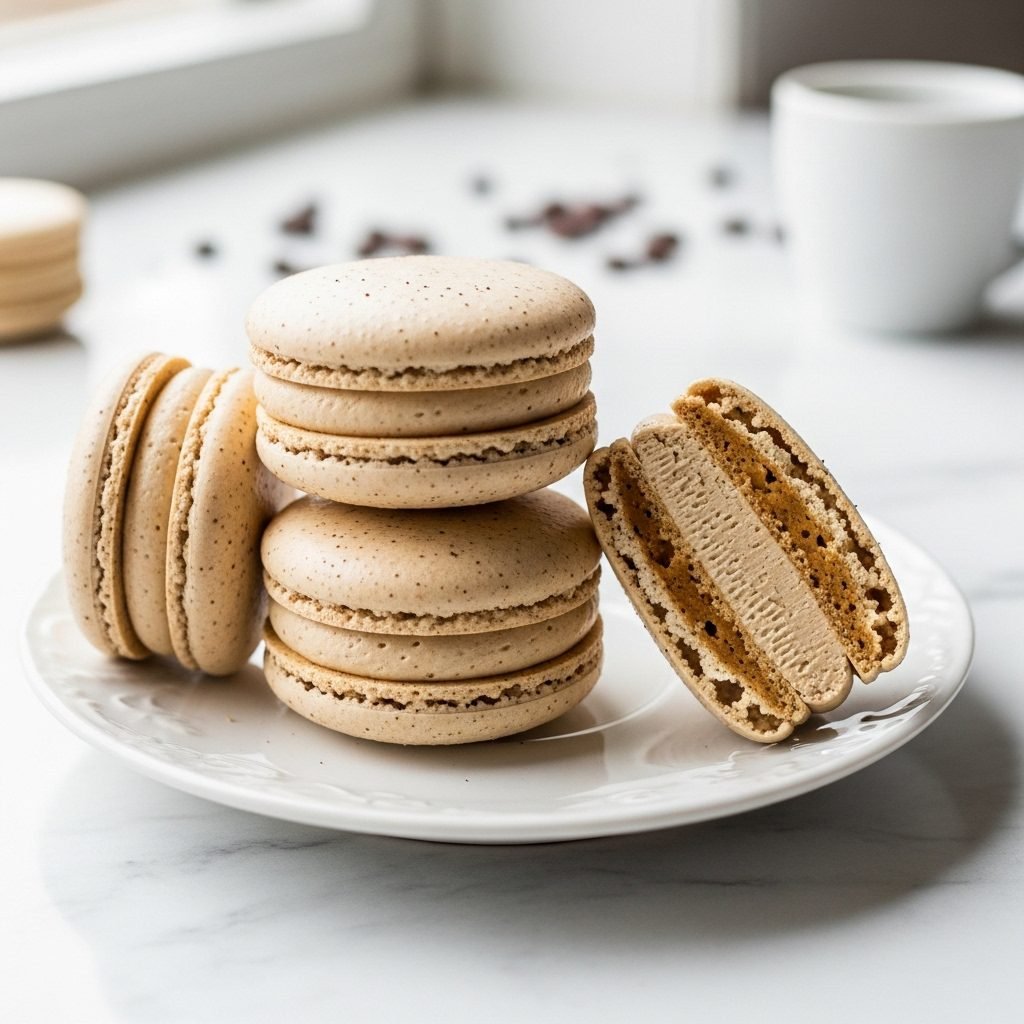
And the flavor? We’re not making a “sweet” cookie. We’re making a coffee cookie. The shells are speckled with real espresso, and the filling is a rich, creamy, robust coffee buttercream. It’s a sophisticated, grown-up, latte-in-a-cookie experience.
This is a “project bake,” a labor of love. So put on your favorite playlist, take a deep breath, and let’s conquer these gorgeous little cookies for good.
What Makes This Recipe So Special
- The Flavor: This is the star. It’s not just “sweet” with a hint of coffee. It’s a deep, rich, robust espresso flavor that shines through the almond-flour shell. It’s a true coffee-lover’s dream.
- The Texture: This is the macaron holy grail. You get that paper-thin, crisp “skin,” which shatters into a light, airy, and chewy center (that’s full, not hollow!). This all sandwiches a rich, creamy, coffee-kissed buttercream.
- The Time: This is a weekend project. Be prepared to spend 2-3 hours in the kitchen, not including the crucial 24-hour “maturing” time.
- The Difficulty: I’ll be honest: this is an intermediate bake. But it’s not about “talent.” It’s about precision. We will use a kitchen scale, we will follow the steps, and the stable Italian method gives us a huge advantage.
Your Ingredients (This is a “Must-Measure” Recipe)
This is my #1 tip. You must use a kitchen scale for macarons.
I’ve included cup measurements for reference, but I cannot and will not guarantee they will work. Baking macarons is pure chemistry. Using grams is the only way to get consistent, beautiful results. This is the first, most important step.
For the Coffee Macaron Shells (Italian Meringue):
- 1 1/2 cups + 1 tbsp (150g) Almond Flour, finely ground
- 1 1/4 cups + 1 tbsp (150g) Powdered Sugar
- 1 1/2 tbsp (10g) Instant Espresso Powder (Do not use ground coffee!)
- 2/3 cup (55g) Egg Whites, at room temperature (from 1-2 eggs)
- 2/3 cup (55g) Egg Whites, at room temperature (a second 55g!)
- 3/4 cup + 2 tbsp (150g) Granulated Sugar
- 1/4 cup + 1 tbsp (60g) Water
For the Espresso Buttercream Filling:
- 1 cup (2 sticks / 226g) Unsalted Butter, very soft, at room temperature
- 2 1/2 cups (300g) Powdered Sugar, sifted
- 1 1/2 tbsp (10g) Instant Espresso Powder
- 1 tbsp Heavy Cream or Milk, at room temperature
- 1 tsp Vanilla Extract
- 1/4 tsp Salt
How to Make Coffee Macarons, Step by Step
Read all the steps before you start. We’ll do this in parts: Buttercream, Shells, and Assembly.
Part 1: The Espresso Buttercream (Make This First)
- In a small bowl, whisk your 1 1/2 tbsp of espresso powder into the 1 tbsp of heavy cream. Set it aside to dissolve.
- In the bowl of your stand mixer (or in a large bowl with a hand mixer), beat the 2 sticks of very soft butter on medium-high speed for 5 minutes. Scrape the bowl down. You’re looking for it to be very pale and fluffy.
- Turn the mixer to low and sift in the powdered sugar, one cup at a time. Mix on low until it’s all combined.
- Add the dissolved espresso-cream mixture, the vanilla extract, and the salt.
- Turn the mixer to medium-high and beat for another 3-4 minutes, until the buttercream is incredibly light, silky, and a creamy light-brown color.
- Transfer the buttercream to a piping bag fitted with a round tip. Set it aside (if your kitchen is warm, pop it in the fridge, but let it come back to a pipe-able temp before using).
Part 2: The Coffee Macaron Shells (The Italian Method)
- Prep Station: Line two large baking sheets with parchment paper or silicone mats. Get your stand mixer (with whisk), digital thermometer, and a small saucepan ready.
- Sift Drys (The “Tant Pour Tant”): Sift the 150g of almond flour, 150g of powdered sugar, and your 1 1/2 tbsp of instant espresso powder together into a large bowl. Whisk them to combine. Sift them again if you can. This is the secret to a smooth, non-bumpy shell.
- Make Slurry: In a separate, medium bowl, add your first portion of egg whites (55g). Add your sifted drys. Mix with a stiff spatula until it forms a thick, stiff, grainy, light-brown paste. Set it aside.
- Start Syrup: In your saucepan, combine the 150g of granulated sugar and 60g of water. Swirl. Clip your thermometer to the side. Heat on medium.
- Start Meringue: Place your second portion of egg whites (55g) in your clean stand mixer bowl.
- The Timing: When the syrup hits 230°F (110°C), turn your mixer on medium-high to whip the whites.
- The Drizzle: You want your whites at “soft peaks” (foamy, peaks just droop) just as your syrup hits 240-244°F (115-118°C).
- Once the syrup is at 240°F, remove it from the heat. Turn the mixer to medium-low. Very carefully, pour the hot syrup in a thin, steady stream down the side of the bowl.
- Whip to Cool: Once all the syrup is in, turn the mixer to medium-high. Let it whip for 8-10 minutes, until the meringue is stiff, glossy, and the outside of the bowl is cool to the touch.
- The Macaronage: Now, we fold. Add about 1/3 of your stiff meringue to the coffee-almond paste and fold it in aggressively to lighten it.
- Fold, Fold, Fold: Add the rest of the meringue. Fold by scraping around the bowl, over the top, and pressing down through the middle. Turn the bowl, and repeat. You’re looking for the “lava” stage: the batter falls from your spatula in a thick, continuous ribbon and “melts” back into the batter within 20 seconds. Stop immediately when you reach this stage.
- Pipe & Slam: Transfer the batter to a piping bag with a 1/2-inch round tip. Pipe 1.5-inch circles, holding the bag straight up and down.
- SLAM: Pick up your baking sheet and slam it hard on the counter 4-5 times. This pops all the air bubbles and prevents cracks.
- Rest (The Skin): This is a must. Let the trays rest at room temperature for 30-60 minutes. They are ready to bake when you can gently touch the top and it’s dry and “tacky,” not sticky.
- Bake: While they rest, preheat your oven to 300°F (150°C). Bake one tray at a time on the center rack for 14-17 minutes. The shells are done when they don’t “wiggle” on their “feet.”
- Cool: Let the shells cool completely on the baking sheet before trying to remove them.
Part 3: Assembly & Maturation (The REAL Secret!)
- Match your cooled, coffee-speckled shells by size.
- Pipe a generous “kiss” of the espresso buttercream onto the flat side of one shell.
- Gently press another macaron shell on top, just until the filling comes to the edge.
- STOP! DO NOT EAT THEM. (This is the most important step!)
- Mature: Place your assembled macarons in an airtight container. Put them in the refrigerator for 24-48 hours. This is “maturing.” The moisture from the filling will soften the inside of the shell, creating that perfect, chewy-crisp, melded texture. This is when the magic happens.
My Top Tips for Coffee Macarons
- Use INSTANT ESPRESSO Powder: This is not optional. Do not use regular ground coffee beans. They are not soluble and will make your shells gritty, bumpy, and might cause them to fail. Instant espresso powder (the kind that dissolves in liquid) is what you need. It gives all the flavor with no gritty texture.
- The SCALE! I will say this on every macaron recipe I ever write. Use a kitchen scale.
- Aged Egg Whites: This is a pro-tip. Separate your egg whites 1-2 days before you bake. Leave them in a bowl in the fridge, covered with a paper towel. This dehydrates them slightly, making a stronger meringue.
- Oven Thermometer: Your oven is lying to you. A $10 oven thermometer is the #1 tool for a macaron baker. 300°F is the sweet spot, but your 300°F might be 315°F or 275°F.
Ingredient Substitutions
- Mocha Macarons: This is an easy and delicious swap! Make a simple chocolate ganache (4 oz semi-sweet chocolate, 1/2 cup heavy cream, 1 tsp espresso powder) and use that as your filling instead.
- Coloring: These shells will naturally be a “latte” color from the espresso powder. If you want them darker, a tiny drop of brown gel food coloring can be added to the slurry in Part 2.
Common Mistakes (The Macaron Autopsy)
- My Shells are CRACKED: You didn’t slam the pan hard enough to get the air bubbles out, OR you didn’t let them rest long enough to form a skin.
- My Shells are HOLLOW: The #1 problem. Usually a meringue issue (not stiff enough) or your oven is too low. The Italian method is your best defense against this.
- My Shells are BUMPY: You didn’t sift your almond flour/powdered sugar, or your espresso powder was too coarse. You must use a fine, dusty, instant powder.
- My Shells are STICKING to the mat: They are under-baked. Put them back in for 2-3 more minutes.
How to Serve and Store
- Serving: After they have “matured” in the fridge, take them out. Let them sit at room temperature for 20-30 minutes before serving. This softens the buttercream slightly and is the perfect eating-texture. They are, obviously, a dream-come-true with a hot cup of coffee.
- Storage: Store your finished macarons in an airtight container in the refrigerator for up to 5 days.
- Freezing: Macarons freeze perfectly! Place them in a single layer in an airtight container. They’ll keep for 3 months. Let them thaw in the fridge.
Coffee Macaron FAQ
Why the Italian Meringue method? It seems hard. It’s actually easier in the long run! It’s more steps, but the hot syrup “cooks” the egg whites, making a meringue that is incredibly stable. It’s less prone to collapsing and less fussy about humidity.
Do I really have to use a kitchen scale? Yes. I’m saying this as your friend. Yes. If you use cups, you are gambling. If you use grams, you are baking.
Do I really have to wait 24 hours to eat them? Yes! A “fresh” macaron is all wrong—it’s crunchy and will fall apart. The “maturing” is when the shell and filling become one. It’s the most important (and hardest) step.
You’ve Conquered the King of Cookies
This is a recipe to be proud of. It takes patience, it takes precision, but the reward is a truly high-end, professional-quality dessert.
When you take that first bite—that crisp, chewy, creamy, robust coffee-punch—you’ll know that every single second was worth it. You’re not just a baker; you’re a macaron master.
A Quick Summary
This “no-fear” recipe guides you through making sophisticated Coffee Macarons. It uses the stable Italian Meringue method for full, chewy, espresso-speckled shells. The shells and the simple, silky buttercream are both infused with real, instant espresso powder for a deep, robust “latte” flavor. The recipe emphasizes precision (using a scale) and the crucial 24-hour “maturing” step.
If you make these, you must show them off! You earned it. Tag me on [Your Social Media Handle] or share a photo of your beautiful “feet.” And if this guide helped you conquer your macaron fears, please share it on Pinterest!