That Shiny Shell & Toasted Nut Flavor: A No-Fear Hazelnut Macaron Guide
Okay, let’s just name the elephant in the room: French macarons are intimidating. They are the most finicky, high-maintenance, and downright dramatic cookie in the baking world. We’ve all seen the pictures—the cracked, volcano-like tops, the sad, flat discs with no “feet,” the dreaded hollow centers.
They have a reputation. And honestly? It’s kind of deserved.
But here is the good news: they are not impossible. They are not magic. They are simply a science. And once you understand the why behind each very specific, very particular step, the fear melts away and it just becomes a process. A fun, rewarding, weekend-consuming process.
This is your in-depth guide. We are going to make a macaron that is, in my opinion, one of the coziest and most delicious: Double Hazelnut.
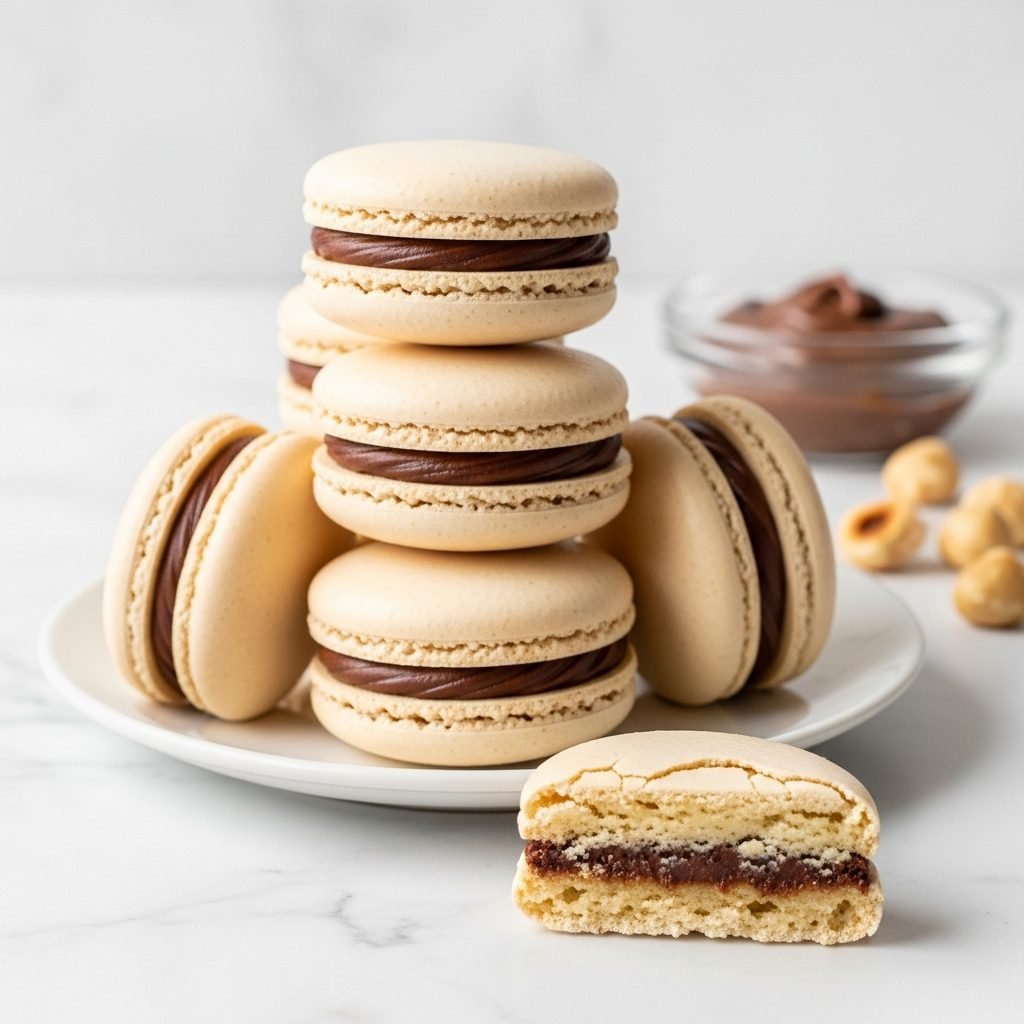
We’re putting real, toasted hazelnut flour into the macaron shells themselves, giving them a deep, nutty, roasted flavor. Then we’re sandwiching them with a rich, creamy, chocolate-hazelnut ganache. The flavor is round, warm, and sophisticated. You can do this. So, take a deep breath, pull out your kitchen scale (yes, you need one), and let’s bake something incredible.
What to Expect from This Recipe
- The Flavor: Deep, toasted hazelnut. The shells have a nutty, roasted flavor that pairs beautifully with the rich, creamy chocolate-hazelnut filling.
- The Texture: The classic, coveted macaron experience. A paper-thin, crisp outer shell that shatters, a wonderfully moist and chewy interior, and a smooth, creamy filling.
- Difficulty: I won’t lie to you: this is an advanced recipe. Not because any single step is hard, but because it demands precision, patience, and following the instructions to the letter.
- What Makes It Special: This is a “double-hit” of hazelnut. Using hazelnut flour in the shells makes a huge difference in flavor, taking it from a simple “Nutella-filled” cookie to a true hazelnut masterpiece.
Ingredients You’ll Need (A Scale is Required!)
This is the most important part of the recipe. You must use a kitchen scale. Macarons are a science of ratios. Measuring by “cups” is too inaccurate and is the #1 reason for macaron failure. I’ve included cup measurements for reference, but I am begging you to use the grams.
For the Chocolate-Hazelnut Ganache (Make This First):
- 4 oz (113g) good-quality semi-sweet chocolate (at least 50%), chopped
- ½ cup (120ml) heavy cream
- 2 tbsp (35g) chocolate-hazelnut spread (like Nutella)
For the Hazelnut Macaron Shells:
- 1 cup (95g) super-fine almond flour
- ¼ cup (25g) hazelnut flour (also called hazelnut meal)
- ¾ cup (100g) powdered sugar
- 3 large egg whites (about 100g), at room temperature
- A pinch of cream of tartar
- ½ cup (100g) granulated sugar
The Step-by-Step Method to Macaron Success
Take this one section at a time. Read the entire section before you start it.
Part 1: Make the Ganache (So It Can Chill)
This needs to be done at least 2 hours ahead, or even the day before, so it has time to chill and set to a pipeable consistency.
- Place your chopped semi-sweet chocolate and the chocolate-hazelnut spread in a medium, heat-proof bowl.
- Pour the heavy cream into a small saucepan. Heat it over medium-low heat just until it begins to simmer (tiny bubbles form around the edges). Don’t let it boil.
- Pour the hot cream directly over the chocolate and spread. Let it sit, untouched, for 5 minutes. This melts the chocolate gently.
- After 5 minutes, start stirring with a small whisk, beginning in the very center and working your way out in concentric circles. It will look like a mess at first, but suddenly it will come together into a smooth, glossy ganache.
- Press a piece of plastic wrap directly onto the surface of the ganache (to prevent a “skin” from forming) and place it in the refrigerator to chill and thicken for at least 2 hours, or until it’s a “pipeable” peanut-butter consistency.
Part 2: Prepare the Macaron Shells
- Prep Your Station: Line two large baking sheets with parchment paper. If you’re new to this, it helps to trace 1.5-inch circles on the underside of the parchment as a guide, leaving 2 inches between them. Set aside a large piping bag fitted with a ½-inch round tip.
- SIFT. SIFT. SIFT. This is non-negotiable for smooth tops. Get a large bowl and a fine-mesh sieve. Add your almond flour, hazelnut flour, and powdered sugar to the sieve. Sift them all together into the bowl.
- SIFT AGAIN. Yes, I’m serious. You’ll be left with some lumpy bits—just discard them. Pour that mixture back into the sieve and sift it a second time. This fine-flour-like texture is what gives you that glossy, professional finish. Set this dry mixture aside.
- Make the Meringue: Place your 100g of room-temperature egg whites in the spotlessly clean, 100% grease-free bowl of a stand mixer (or a large glass/metal bowl). Any trace of fat or yolk will ruin your meringue.
- Add the pinch of cream of tartar. Whip on medium-low speed until the whites are foamy (like a bubble bath).
- Turn the speed to medium. Start adding your 100g of granulated sugar, one tablespoon at a time, very slowly, waiting 20-30 seconds between additions. This slow addition is key to a stable, strong meringue.
- Once all the sugar is added, turn the mixer speed up to medium-high. Whip for 5-8 minutes, until the meringue is incredibly thick, glossy, and forms stiff peaks. This means when you pull the whisk out, a peak forms and stands straight up. It should not flop over. If you turn the bowl upside down, the meringue should not move at all.
Part 3: The “Macaronage” (The Most Important Step)
This is the process of folding the dry ingredients into the meringue. It’s where you get the “lava” consistency.
- Add about ⅓ of your sifted dry ingredients to the meringue. Using a spatula, gently fold them in. Use a “scrape and fold” motion—scrape around the edge of the bowl, then fold the batter over the top. Turn the bowl a quarter turn and repeat.
- Add the second ⅓ of the dry ingredients and continue to fold gently until it’s just combined.
- Add the final ⅓ of the dry ingredients. Now, your technique changes. Continue folding, but start to be a bit more “firm.” You are intentionally deflating some of the air. Start to press the batter against the side of the bowl with your spatula as you fold.
- The “Lava Test”: This is how you know it’s ready. Lift your spatula and let the batter fall back into the bowl. It should fall in a thick, continuous, “molten lava” ribbon, and you should be able to “draw” a figure-8 with the ribbon without it breaking.
- The “10-Second Test”: The ribbon of batter that fell into the bowl should slowly dissolve back into the surface in about 10-15 seconds.
- If it’s lumpy and doesn’t flow: It’s under-mixed. Fold a few more times.
- If it’s thin and watery: It’s over-mixed. Unfortunately, there is no saving it.
- As soon as you hit the “lava” stage, STOP.
Part 4: Piping, Whacking, and Resting
- Transfer your macaron batter to the prepared piping bag.
- Hold the bag straight up and down (perpendicular to the pan) and pipe your 1.5-inch circles. Stop squeezing just before the circle is full, and flick the tip of the bag in a “C” motion to finish.
- WHACK THE TRAYS. This is not a suggestion. Pick up one baking sheet and rap it hard on your counter 5-6 times. Rotate it and do it again. This forces any large, hidden air bubbles to the surface. (If you see any bubbles, pop them with a toothpick). Teleport
- THE REST. This is the second non-negotiable step. Let the trays of piped macarons sit at room temperature for 30-60 minutes (this can vary wildly based on humidity).
- The “Touch Test”: They are ready to bake when you can gently touch the top of a macaron, and it’s dry, matte, and not sticky. Your finger should come away clean. This dry “skin” is what forces the macaron to bake up and create “feet” (the ruffled bottom).
Part 5: Baking and Maturing
- While the shells rest, preheat your oven to 300°F (150°C). An oven thermometer is highly recommended, as most ovens are not accurate.
- Bake one tray at a time on the middle rack for 15-18 minutes.
- The “Wiggle Test”: They are done when the tops are firm and set. Gently nudge the top of one shell. If the “foot” wiggles or slides around, they need 1-2 more minutes. The top should be firm on its foot.
- Let the shells cool completely on the baking sheet before you even think about peeling them off the parchment.
Part 6: Assembly and Maturation (The Final Secret)
- Gently peel your cooled shells off the parchment. Match them up into pairs by size.
- Transfer your chilled, thickened ganache to a piping bag. Pipe a dollop of ganache onto the flat side of one shell.
- Gently press a second shell on top, twisting slightly to spread the ganache.
- THE MOST IMPORTANT STEP FOR TEXTURE: Place your filled macarons in an airtight container and put them in the refrigerator for 24 hours. This is called “maturing.” The ganache’s moisture softens the inner shell, transforming it from “crispy” to “chewy.” Do not skip this.
My Top Tips for Macaron Success
- USE A SCALE. I’m saying it again for the people in the back. This is a 1:1 ratio of egg whites to granulated sugar, and roughly a 1.2:1 ratio of nut flours to egg whites. Cups will not work.
- SIFT. SIFT. SIFT. This is the secret to those smooth, glossy tops.
- A SPOTLESS BOWL. Any fat (yolk, grease) will kill your meringue. Wipe your bowl and whisk with white vinegar to be 100% sure.
- RESPECT THE MACARONAGE. Watch a video of it if you need to. It’s a “feel” you will learn. Under-mixed is better than over-mixed.
- THE WHACK & REST. Mandatory. These two steps release air and form the skin that creates the feet.
- KNOW THY OVEN. An oven thermometer is your best friend. Most home ovens are lying about their temperature.
- PATIENCE. Do not take them off the pan hot. Do not eat them right away. Let them cool. Let them mature.
Substitutions & Dietary Options
- Hazelnut Flour: If you can’t find it, you can just use all almond flour (120g total). The shells won’t be as nutty, but the filling will still provide that hazelnut punch.
- Cream of Tartar: You can substitute 1 tsp of white vinegar or fresh lemon juice for the pinch of cream of tartar. It’s just a stabilizer for the meringue.
- Gluten-Free: This recipe is naturally 100% gluten-free!
- Dairy-Free: The shells are dairy-free. For the ganache, use a high-quality dairy-free semi-sweet chocolate, a dairy-free chocolate-hazelnut spread (many are), and substitute the heavy cream with an equal amount of full-fat canned coconut cream (the thick white part only).
Common Mistakes to Avoid (A Troubleshooting Guide)
- Why do my macarons have NO “FEET”?
- Your batter was over-mixed (too thin), or you didn’t let them rest long enough to form a dry skin.
- Why did my macarons CRACK on top?
- Your batter was under-mixed (too thick), you didn’t “whack” the air bubbles out, or your oven was too hot.
- Why are my macarons HOLLOW?
- Your meringue was under-whipped (not stiff enough), your oven was too low, or you over-mixed the batter. This is the trickiest problem!
- Why did they spread out and get FLAT?
- Your batter was way over-mixed.
- Why are they STICKY and CHEWY (not crisp)?
- You under-baked them, or it’s a very humid day. Try to make macarons on a dry, cool day!
- Why are my shells lumpy?
- You didn’t sift your flours enough. The hazelnut flour can be coarser, so sifting is extra important here.
Serving and Storing Your Masterpieces
- Serving: Always let your macarons come to room temperature for 20-30 minutes before serving. This is crucial! The ganache will soften, and the shell will have the perfect crisp-chewy texture.
- Storage: Store the filled, mature macarons in an airtight container in the refrigerator for 3-5 days.
- Freezing: Macarons freeze beautifully. Place the mature macarons in a single layer in an airtight container and freeze for up to 3 months. Let them thaw in the fridge, then bring to room temp before eating.
Your Macaron Questions, Answered
- What are “aged” egg whites?
- Some bakers swear by letting egg whites sit in the fridge for 24-48 hours. I find that as long as your whites are 100% room temperature and you whip them to a very stiff, stable meringue, you will be successful.
- Why do I have to use grams?
- Baking is chemistry, and macarons are the most sensitive experiment. A “cup” of almond flour can vary in weight by 10-20g depending on how packed it is. That’s enough to ruin the recipe. A scale is your key to consistency and success.
- Can I reduce the sugar?
- No. In macarons, sugar is a structural ingredient, not just a sweetener. It’s what creates the shell, the chew, and the stability. The recipe will fail if you reduce the sugar.
A Rewarding, Toasty Challenge
Macarons are a journey. Your first batch might not be window-display-ready. But they will still be delicious (it’s hard to mess up almond, hazelnut, and chocolate!). Don’t be discouraged. Every batch teaches you something new. When you pull that first tray of shiny, full-footed, fragrant shells from the oven, you will feel like a true pâtissier.
Recipe Summary
This is a detailed, step-by-step guide to making sophisticated “double” hazelnut French macarons. The recipe focuses on the French meringue method and breaks down the most critical techniques, including using a mix of almond and hazelnut flours, sifting, creating a stable meringue, and mastering the “macaronage.” The nutty shells are filled with a rich chocolate-hazelnut ganache and “matured” in the refrigerator for 24 hours to develop their signature chewy texture.
You Did It! Share Your Bake!
If you take on this toasty challenge, I have to see your results! Did you get feet? What did you learn? Tag me on social media [Your Social Handle Here] or leave a comment below. And if this guide helped you, please Pin this recipe to help other aspiring macaron bakers!
Happy baking!