Classic Nougat de Montélimar Recipe with Soft Honey & Almond Flavor
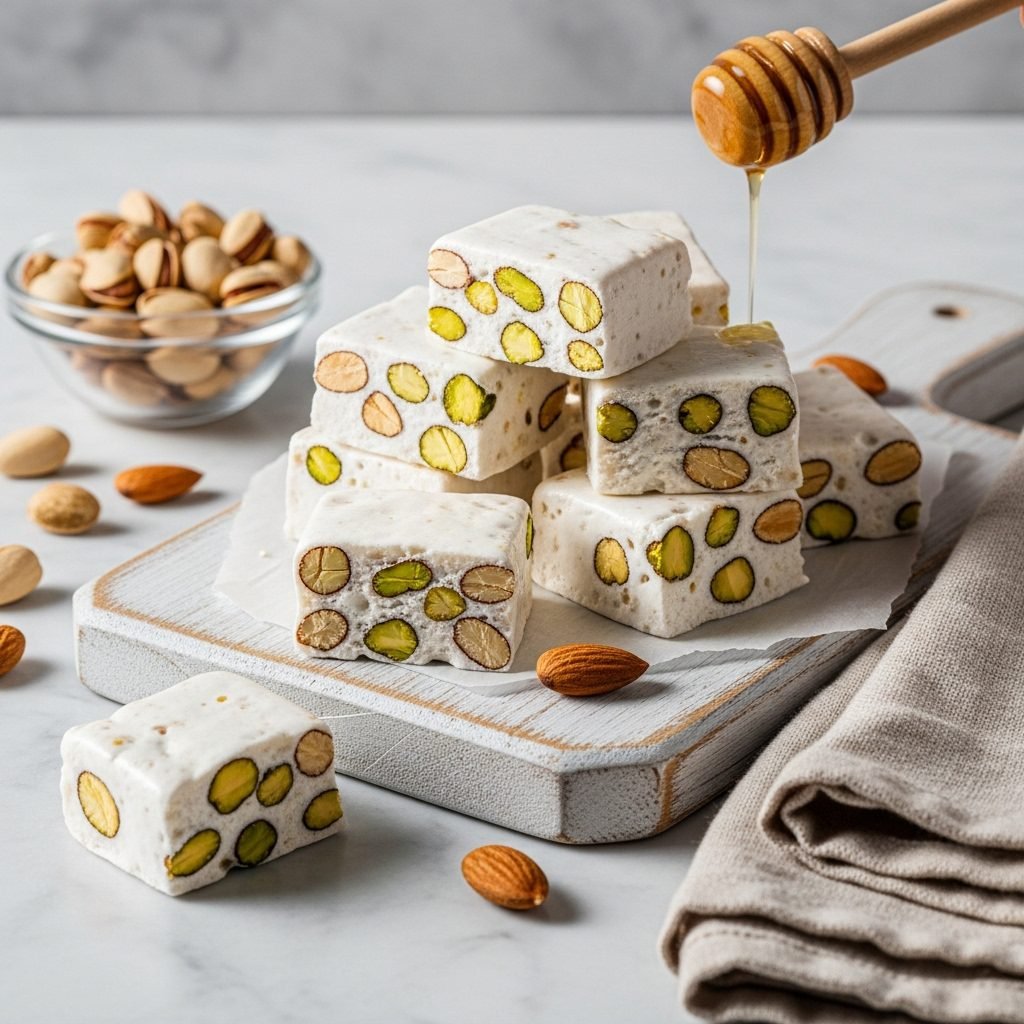
There is something truly magical about classic French nougat. That soft, chewy bite that isn’t sticky or tough, packed with crunchy toasted almonds and bright green pistachios, all held together by a light-as-air, honey-kissed confection… it’s pure heaven.
If you’ve ever walked past a fancy French patisserie and marveled at those beautiful, snow-white bars, you were probably looking at Nougat de Montélimar. It looks intimidating, like something only a professional candy-maker with years of training could pull off.
I used to think that, too.
Candy making can be scary! It involves bubbling-hot sugar, precise temperatures, and a lot of sticky spatulas. But I’m here to tell you that this recipe is different. I’ve broken down every single step to make it as simple and foolproof as possible.
This recipe creates a soft nougat (nougat tendre), not the tooth-breaking hard kind. It’s wonderfully chewy, delicately sweet, and packed with so many nuts it’s almost savory. It’s the kind of treat you cut into small squares and savor with a cup of coffee or tea.
And the best part? Making it at home feels like a real accomplishment. If you’re ready to tackle a fun (and delicious) kitchen project, you are in the right place. Let’s make the dreamiest nougat you’ve ever tasted.
Why You’ll Fall in Love with This Nougat
This isn’t just any nougat. Here’s what makes this specific recipe so special:
- The Taste: It’s a beautiful, sophisticated balance of flavors. You get the floral, aromatic notes from the honey (use a good one!), a warm kiss of vanilla, and a deep, nutty richness from the almonds and pistachios. It’s sweet, but not cloyingly so.
- The Texture: We are aiming for the gold standard: soft and chewy. It has a satisfying, substantial bite but melts in your mouth without sticking to your teeth. The toasted nuts provide a fantastic, crunchy contrast.
- The Time: I’ll be honest, this isn’t a 20-minute recipe. You’ll need about an hour of active kitchen time, mostly watching a thermometer and letting your mixer do the work. The hardest part is the (mostly) hands-off waiting time—it needs at least 4 to 6 hours, or preferably overnight, to set up properly.
- The Difficulty: Let’s call it an “Ambitious Beginner” or “Intermediate” project. If you have a stand mixer and a candy thermometer, you are 90% of the way there. The most important skill you need is patience and preparation. Read the recipe all the way through before you start.
- It’s a Showstopper: This nougat looks incredibly impressive. It’s naturally gluten-free and dairy-free, and it makes the most wonderful homemade gift for the holidays, birthdays, or just because.
What You’ll Need to Make French Nougat
The ingredients are simple, but their quality matters. A really good, floral honey will make a huge difference.
- 1 ½ cups raw, blanched (skinless) almonds
- ½ cup raw, shelled pistachios (unsalted)
- 2 large egg whites, at room temperature
- ⅛ tsp fine sea salt
- ½ cup high-quality light-colored honey (like clover, acacia, or orange blossom)
- 1 ½ cups granulated sugar
- ⅓ cup light corn syrup
- ¼ cup water
- 1 ½ tsp pure vanilla extract
- ½ tsp almond extract (optional, but lovely)
- 2 sheets of edible wafer paper (to fit an 8×8 or 9×9 inch pan)
Special Equipment You’ll Need:
- A stand mixer with a whisk and paddle attachment. (A hand mixer is not recommended here.)
- A reliable digital candy thermometer. This is non-negotiable!
- A small saucepan
- A silicone spatula (or two!)
Let’s Make Nougat! Step-by-Step
First: read all the steps. Once the sugar starts cooking, things move fast, so you need to have everything ready to go.
Step 1: Get Everything Ready (Mise en Place)
This is the most important step!
- Line Your Pan: Take an 8×8 or 9×9 inch square baking pan. Lightly grease the bottom and sides, then line it with parchment paper, leaving some overhang on the sides to act as “handles.”
- Add Wafer Paper: Trim one sheet of your edible wafer paper to fit snugly in the bottom of the pan. Place it on top of the parchment paper.
- Prep Station: Get your stand mixer bowl and whisk attachment clean and ready. Measure out all your ingredients into separate bowls. Have your thermometer, spatula, and saucepan nearby.
Step 2: Toast the Nuts
- Preheat your oven to 325°F (165°C).
- Spread the almonds and pistachios on a baking sheet in a single layer.
- Toast for 10-12 minutes, or until the almonds are just beginning to turn a pale golden and smell nutty. Don’t let them get dark.
- Turn the oven off, but leave the nuts in the warm oven (with the door ajar) while you do the next steps. You want to add warm nuts to the nougat, not cold ones.
Step 3: Start the Meringue
- In the clean, dry bowl of your stand mixer, combine the room-temperature egg whites and the fine sea salt.
- Whip on medium-high speed until they form soft peaks—this is when the peaks flop over when you lift the whisk.
- Stop the mixer for now. We’ll come back to it in a moment.
Step 4: Cook the Honey Syrup
- Pour the honey into your small saucepan.
- Clip your candy thermometer to the side, making sure the tip is submerged but not touching the bottom of the pan.
- Heat the honey over medium heat until it reaches 250°F (121°C).
- Once it hits 250°F, remove it from the heat.
Step 5: Combine Meringue + Honey
- Turn your stand mixer (with the soft-peak egg whites) back on to medium speed.
- Very slowly, in a thin, steady stream, drizzle the hot honey down the side of the bowl into the whipping egg whites.
- Once all the honey is added, increase the speed to high and let it whip while you make the sugar syrup. This creates a stable, glossy honey meringue.
Step 6: Cook the Sugar Syrup
- Do not clean the saucepan! A little leftover honey is fine.
- Add the granulated sugar, light corn syrup, and water to the pan.
- Stir just once with a clean, heatproof spatula to combine.
- Clip the candy thermometer back onto the pan.
- Cook over medium-high heat, without stirring (this is key to prevent crystallization!), until the syrup reaches 285°F (140°C). This temperature gives you a soft, chewy nougat.
- Pro Tip: If you see sugar crystals forming on the side of the pan, dip a pastry brush in water and gently “wash” them down into the syrup.
Step 7: Combine Meringue + Sugar Syrup
- As soon as the sugar syrup hits 285°F, remove it from the heat.
- Turn the stand mixer (which is still whipping your honey meringue) down to medium-low speed.
- Just like with the honey, pour the hot sugar syrup in a very slow, steady stream down the side of the bowl. Be careful, this stuff is hot. Avoid pouring it directly onto the whisk, or it will splatter.
- Once all the sugar syrup is added, turn the mixer up to high speed.
Step 8: The Long Whip
- Let the mixer run on high speed for 5 to 10 minutes.
- You’ll see the mixture transform. It will become very thick, glossy, and triple in volume. It will look like a giant, sticky marshmallow.
- The nougat is ready for the next step when the outside of the mixing bowl is no longer hot, just lukewarm, and the nougat starts to pull away from the sides.
Step 9: Fold in the Goodies
- Stop the mixer and remove the whisk attachment. (Have fun cleaning that later—soaking in hot water is your friend!)
- Switch to the paddle attachment (if you have one) or just use a very sturdy, lightly-greased silicone spatula.
- Add the warm, toasted nuts, the vanilla extract, and the almond extract (if using) all at once.
- Mix on the lowest possible speed (or by hand) for just 15-30 seconds, until the nuts are just combined. Do not overmix!
Step 10: Press and Set
- This is the sticky part! Work fast. Scrape the very thick nougat mixture into your prepared 8×8 pan, on top of the wafer paper.
- Lightly grease your spatula or your hands. Press the nougat down into an even layer, pushing it into the corners.
- Trim your second sheet of wafer paper to size and press it firmly on top of the nougat.
- To get a really flat, professional-looking bar, you can use the bottom of a measuring cup or a second, smaller pan to press it down firmly and evenly.
Step 11: The Hardest Part—The Wait
- Leave the pan of nougat on your counter, uncovered, at room temperature for at least 4 to 6 hours.
- Overnight is even better! This allows it to fully set and dry out just the right amount.
- Do not refrigerate it! The fridge is humid and will make your nougat weepy and sticky.
Step 12: Cut and Enjoy
- Once fully set, use the parchment paper “handles” to lift the entire block of nougat out of the pan.
- Place it on a large cutting board.
- Get your largest, sharpest knife. Heavily grease the blade with neutral oil or cooking spray.
- Press down firmly to cut the block into small 1-inch squares or 1×2-inch rectangles.
- You will need to wipe the knife clean and re-grease it between every few cuts. This is the secret to clean, non-sticky pieces.
My Top Tips for Nougat Success
- Watch the Weather: I’m serious. Humidity is the number one enemy of candy making. Try to make this on a clear, dry day. If it’s humid or raining, your nougat may struggle to set and will be much stickier.
- Trust Your Thermometer: This entire recipe hinges on two numbers: 250°F and 285°F. Your thermometer must be accurate. Test it in a pot of boiling water first—it should read 212°F (100°C) at sea level.
- Warm Nuts are Key: Adding cold nuts to the hot nougat mixture can cause it to “seize” or set up too quickly, making it impossible to spread. Keeping them in the warm oven until the last second is the perfect trick.
- Grease Everything: When it’s time to spread and cut, grease is your best friend. Grease your spatula, grease your knife, even grease your hands. It makes handling the sticky nougat a million times easier.
- Patience, Patience, Patience: Don’t rush the setting time. If you try to cut it too early, you’ll have a sticky, gooey mess. Let it sit overnight. You’ll be rewarded with perfect, chewy squares.
Recipe Variations & Substitutions
- For the Nuts: The classic Montélimar style is almonds and pistachios. But feel free to change it up! Toasted hazelnuts are incredible. You could also use pecans or walnuts.
- For the “Fruit”: Want to add a different texture? Fold in some dried cranberries, chopped dried apricots, or candied orange peel along with the nuts.
- For the Honey: You must use honey for the flavor and texture, but the type is up to you. A light-colored, mild honey like clover or acacia is traditional. A darker honey like wildflower will give it a more robust, molasses-like flavor.
- About Corn Syrup: Please don’t skip it. It’s an “invert sugar,” which is a fancy way of saying it stops the granulated sugar from forming large crystals. This is what guarantees a smooth, chewy nougat, not a gritty, grainy one. You can substitute it with glucose syrup if you have that.
- Gluten-Free Option: This recipe is naturally gluten-free! Just double-check that your edible wafer paper is made from potato or rice starch (most are) and not wheat.
- Dairy-Free Option: This recipe is also naturally dairy-free.
- A Note on a Vegan Option: This recipe relies heavily on egg whites and honey. While I’ve seen experimental recipes using aquafaba (chickpea brine) and vegan honey substitutes, I haven’t tested them for this specific recipe. The texture and chemistry would be quite different.
Common Nougat Troubles & How to Fix Them
- “My nougat is runny and won’t set.”
- The Problem: Your sugar syrups didn’t get hot enough. If you pull it off the heat even a few degrees too early, it won’t have the right structure to set.
- The Fix: Unfortunately, you can’t really fix this batch. Double-check your thermometer’s accuracy for next time and be patient!
- “My nougat is rock-hard and brittle.”
- The Problem: Your sugar syrups got too hot. If you let the sugar syrup go up to 295-300°F, you’ve made hard-crack candy, not soft nougat.
- The Fix: Break it into pieces and enjoy it as a hard candy! And next time, pull it off the heat the second it hits 285°F.
- “My sugar syrup turned into a solid, grainy clump.”
- The Problem: It crystallized. This can happen if you stirred it while it was boiling, if there was a stray sugar crystal on the side of the pot, or if you didn’t use corn syrup.
- The Fix: You have to start the syrup over. To prevent it, use a clean pot, don’t stir (just swirl the pan if needed), and use a wet pastry brush to wipe down any crystals on the side of the pan.
- “My meringue deflated when I added the syrup.”
- The Problem: You probably added the syrup too quickly, which “cooked” and scrambled the egg whites instead of incorporating.
- The Fix: Go slow. A tiny, thin stream is all you want. Think of it like making mayonnaise, but with lava-hot sugar.
How to Serve Your Beautiful Nougat
This treat is rich, so small pieces go a long way.
- On a Cookie Platter: It’s the most sophisticated-looking item on any holiday cookie tray.
- With Coffee or Tea: The perfect 3 PM pick-me-up.
- On a Cheese Board: This is my favorite. The sweet, nutty, chewy nougat is incredible next to a sharp, salty cheese like an aged cheddar, Manchego, or a creamy blue.
- As a Homemade Gift: This is the ultimate gift. Cut the pieces, wrap each one individually in a small square of parchment paper or cellophane, and place them in a beautiful tin or box. Tie it with a ribbon, and you’ve just won the holidays.
How to Store Your Homemade Nougat
Do not put it in the refrigerator.
Nougat is “hygroscopic,” meaning it loves to absorb moisture from the air. The fridge is a humid environment and will make your nougat melt and weep.
The best way to store it is in an airtight container at room temperature.
For best results, wrap each individual square in plastic wrap or parchment paper, and then place them in the container. This keeps them from sticking together. Stored this way, your nougat will stay fresh and chewy for up to two weeks.
You can also freeze it! Wrap the pieces tightly in plastic wrap and place them in a freezer-safe bag or container. It will last for up to 3 months. Let it thaw at room temperature before eating.
Your Nougat Questions, Answered
Do I really, really need a candy thermometer? Yes. 100%. I wish I could tell you otherwise, but this is a science recipe. The difference between 275°F and 285°F is the difference between a soupy mess and a rock-hard candy. You need the precision.
Where do I even find edible wafer paper? It’s much easier to find than you think! Amazon has tons of options. You can also find it at specialty baking supply stores. It’s usually called “wafer paper” or “rice paper” (though it’s often made of potato starch).
Can I make this with a hand mixer? I truly don’t recommend it. You need to be pouring 285°F sugar with one hand while the mixer is running with the other. A stand mixer is almost essential for safety and for getting the right texture. The nougat also needs to be whipped for a long, continuous time, which would be exhausting with a hand mixer.
Why light corn syrup? Is it the same as high-fructose corn syrup? No, they are not the same! Light corn syrup (like the Karo brand) is an invert sugar that is 100% glucose. It has no fructose. Its only job here is to chemically block the granulated sugar from crystallizing, ensuring your nougat is smooth and not gritty.
My nougat is sticking to everything! Help! Welcome to candy making! This is normal. The trick is to grease everything it touches once it’s out of the bowl. Grease your spatula for spreading. And most importantly, use a large, sharp knife that you have coated in neutral oil or cooking spray to cut it. Wipe and re-oil the blade between cuts. It’s a game-changer.
A Sweet (and Chewy) Success
Making nougat from scratch feels like a real accomplishment… because it is! You’ve successfully wrangled hot sugar, tamed an egg-white meringue, and created a truly artisanal French confection right in your own kitchen.
That first bite of soft, chewy, honey-almond-pistachio goodness is so, so worth it. I hope you love this recipe as much as I do. It’s a project, but it’s a truly rewarding one.
Recipe Summary
This recipe guides you through making a classic, soft and chewy French Honey-Almond Nougat (Nougat de Montélimar). By carefully cooking honey and sugar syrups to precise temperatures (250°F and 285°F) and whipping them into an Italian meringue, you create a stable, airy base. Fold in warm, toasted almonds and pistachios, then let the mixture set overnight on edible wafer paper. The result is a sophisticated, naturally gluten-free confection that’s perfect for gifts or special occasions.
Did You Make This? Share It!
If you tried this nougat recipe, I would be so happy to see it! It’s such a fun one to show off.