Authentic Turkish Delight Recipe with Soft, Floral Flavor
I think for so many of us, our first introduction to Turkish Delight was through a snow-covered wardrobe. That magical, enchanted-looking confection that Edmund Pevensie betrayed his family for? It had to be something otherworldly.
For years, I was only familiar with the mass-produced, overly-sugared, stiff jelly squares sold in boxes. They were… fine. But they weren’t magic.
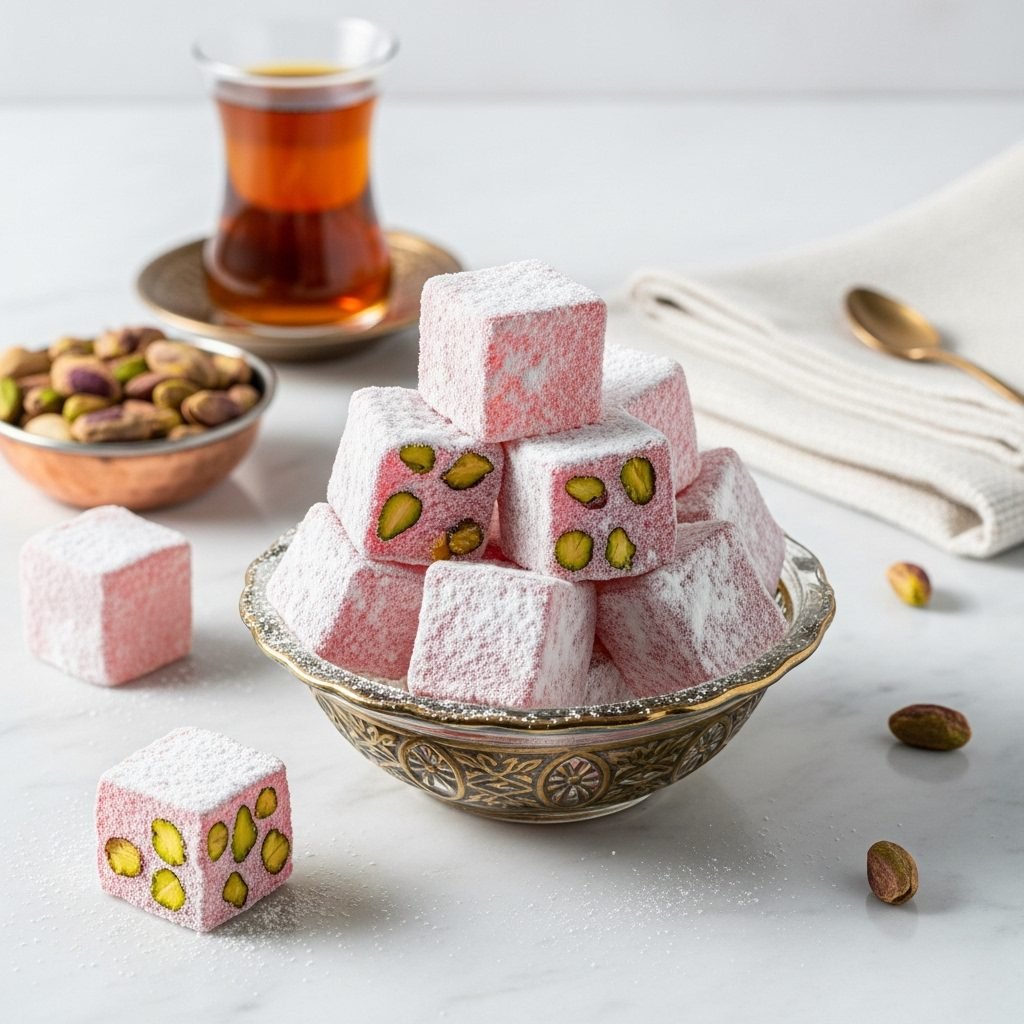
Real, authentic Turkish Delight, or Lokum, is something else entirely. It’s a specialty of Istanbul, a confection with centuries of history. When it’s made well, it’s a revelation. It’s delicate, soft, and wonderfully chewy, with a gentle, wobbly texture. It’s not stiff like a gummy (it has no gelatin) and it’s not sticky like a caramel. It’s a cloud-like gel, perfumed with fragrant rose water and studded with bright green pistachios.
It seems like pantry magic. How do you get sugar and cornstarch to do that?
I was so intimidated to try this at home. Candy making can be fussy, and this recipe involves a thermometer and a lot of stirring. But I’m here to tell you it’s not magic, it’s just chemistry, and it is one of the most rewarding (and surprisingly straightforward) candy projects you can ever try. The result is so much better than anything you can buy in a box.
If you’re ready to feel like a true confectioner (and create a treat that is genuinely enchanting), let’s make some real-deal Turkish Delight.
What to Expect: A Quick Look
- The Taste: Incredibly delicate and aromatic. The primary flavor is the floral, fragrant rose water, balanced by the clean sweetness of the sugar and the rich, nutty, almost-savory crunch of the pistachios.
- The Texture: This is the real star. It’s soft, tender, and has a signature “chew” that gives way easily. It’s not sticky or gummy at all, and the cubes are dusted in a snowy-soft layer of powdered sugar and cornstarch.
- The Time: Let’s be honest: this is a project. You’ll need about 1.5 hours of active kitchen time, and a lot of that is just meditative stirring. The hardest part is the hands-off time: it needs to set for at least 8 hours, or preferably overnight.
- The Difficulty: I’d call this “Intermediate.” Not because any single step is hard, but because it requires two things: a candy thermometer and patience. You can’t rush this recipe.
- It’s a Showstopper: These little pink-hued, pistachio-studded cubes look like jewels. They are naturally vegan, gluten-free, and dairy-free, and they make an absolutely stunning homemade gift for holidays or any special occasion.
What You’ll Need (Your Lokum Ingredients)
The ingredients are simple, but the process is what transforms them.
For the Sugar Syrup:
- 1 ½ cups (12 oz) water
- 4 cups (28 oz or 800g) granulated sugar
- 1 tbsp fresh lemon juice
For the Starch Slurry (The Gelling Base):
- 3 cups (24 oz) cold water
- 1 cup (4.5 oz or 130g) cornstarch
- 1 tsp cream of tartar
For Flavor & Mix-ins:
- 1 ½ tbsp rose water (use a high-quality one, it’s the main flavor!)
- 1-2 drops pink or red gel food coloring (optional, but it gives the classic look)
- 1 cup (about 4.5 oz) raw, shelled pistachios, lightly toasted and unsalted
For the Dusting (Absolutely Essential):
- 1 cup (4 oz) powdered sugar
- ½ cup (2 oz) cornstarch
Special Equipment You’ll Need:
- A reliable digital candy thermometer. This is non-negotiable.
- One small saucepan (for the sugar syrup)
- One large, heavy-bottomed pot or Dutch oven (at least 4-5 quarts)
- A whisk
- A heatproof silicone spatula
- An 8×8 or 9×9 inch baking pan
Let’s Make Turkish Delight! Step-by-Step
First, read all the steps. This is a recipe where you need to have everything ready before you start.
Step 1: Get Everything Ready (Mise en Place)
- Prep Your Pan: Lightly grease your 8×8 or 9×9 inch pan with a neutral oil or cooking spray. Line it with parchment paper, leaving overhang “handles” on two sides. Lightly grease the parchment paper as well. This stuff will stick, so be thorough.
- Toast Nuts: If your pistachios aren’t toasted, spread them on a baking sheet and toast at 325°F for 5-7 minutes. Let them cool.
- Mix Your Dusting: In a small bowl, whisk together the 1 cup powdered sugar and ½ cup cornstarch. Set it aside.
- Measure Everything: Have all your ingredients measured out and ready to go next to your stove.
Step 2: Make the Sugar Syrup
- In your small saucepan, combine the 4 cups of sugar, 1 ½ cups of water, and 1 tbsp of lemon juice.
- Stir over medium heat just until the sugar has dissolved.
- Clip your candy thermometer to the side of the pan, making sure the tip is submerged but not touching the bottom.
- Bring to a boil and let it cook, without stirring, until the thermometer reaches 240°F (115°C). This is the “soft ball” stage.
- Once it hits 240°F, remove it from the heat and set it aside.
Step 3: Make the Starch Slurry
- While the sugar syrup is cooking, start your slurry.
- In your large, heavy-bottomed pot (off the heat!), add the 3 cups of cold water, 1 cup of cornstarch, and 1 tsp of cream of tartar.
- Whisk it all together until it’s perfectly smooth and no lumps of cornstarch remain. It will just look like cloudy water.
Step 4: Cook the Slurry
- Place the large pot with the slurry on the stove over medium heat.
- Whisk constantly. Do not walk away. The mixture will go from milky water to a thicker liquid, and then suddenly, it will thicken into a very stiff, white, glue-like paste. This should take about 5-10 minutes.
- Keep stirring and cooking for 1-2 minutes after it becomes a thick paste.
Step 5: Combine the Syrup and Slurry
- This is the tricky part. Turn the heat under your starch paste to low.
- Very slowly, in a thin, steady stream, begin pouring the hot sugar syrup into the starch paste, whisking vigorously the entire time.
- It will look like a lumpy, separated mess at first. Don’t panic! Just keep whisking and slowly adding the syrup.
- Once all the syrup is added, the mixture should smooth out into one cohesive, translucent, very sticky gel.
Step 6: The Long, Slow Cook (This is the Secret!)
- Switch from your whisk to a heatproof silicone spatula.
- Keep the pot on low heat.
- Now, you need to stir. You’re going to stir this mixture constantly, or at least every 1-2 minutes, for 45 to 60 minutes.
- I know this sounds long, but this is the magic step. This hour of low-heat cooking evaporates excess water, which is what gives the Lokum its signature firm, chewy texture. If you skip this, it will be a soupy mess.
- Set a timer, put on a podcast, and stir. Scrape the bottom and sides to prevent scorching.
- You’ll know it’s ready when the gel has turned from a pale, milky white to a deeper, translucent, pale golden color. It will be extremely thick and will start to pull away from the sides of the pot as you stir.
Step 7: Flavor and Fill
- Turn off the heat. Work quickly now, as the gel will start to set.
- Pour in the rose water and the pink gel food coloring. Stir vigorously to combine.
- Add the toasted pistachios and stir to distribute them evenly.
Step 8: Pour and Set
- Scrape the very thick, sticky gel into your prepared, greased-and-lined pan.
- It will be tough to spread. You can lightly grease your spatula (or an offset spatula) to help you press it into an even layer.
- Leave the pan on the counter, uncovered, at room temperature, for at least 8 hours, or preferably overnight.
- Do not refrigerate it! The humidity in the fridge will make it weepy and prevent it from setting correctly.
Step 9: Cut and Dust
- This is the fun part! Sift a very generous layer of your powdered sugar/cornstarch mixture onto a large, clean cutting board.
- Use the parchment “handles” to lift the set block of Turkish Delight out of the pan.
- Place it, top-side-down, onto the bed of powder. Peel off the parchment paper.
- Sift another very generous layer of powder all over the top of the block.
- Grease a large, sharp knife or a bench scraper with oil (or dust it heavily with the powder). Press firmly to cut the block into 1-inch squares.
- As you cut each piece, toss it immediately into a bowl containing the rest of your dusting mixture.
- Toss to coat every single sticky side. This powder is what keeps them from sticking to each other.
My Top Tips for Lokum Success
- Patience is the Main Ingredient: I can’t say this enough. If you try to rush the 45-60 minute cook time, your Turkish Delight will not set. It will be a soupy, sticky gel. Put in the stirring time. It’s worth it.
- A Heavy-Bottomed Pot is Your Best Friend: A thin pot will create hot spots, causing the cornstarch and sugar to scorch on the bottom, leaving you with brown, burnt-tasting flecks. A heavy Dutch oven or pot is a life-saver here.
- Stir Constantly: This goes with the tip above. You must keep the mixture moving to prevent scorching and ensure even cooking. Scrape the bottom and corners of the pot continuously.
- Cream of Tartar is Important: This is an acid that works with the lemon juice to act as an “invert sugar.” This is a fancy way of saying it stops the granulated sugar from forming large, gritty crystals. It’s key to that smooth, chewy texture.
- Be Fearless with the Dusting Powder: Don’t be shy! You cannot use too much. This powder is the only thing that makes the Lokum manageable and keeps the squares separate.
Recipe Variations & Dietary Notes
- Flavoring: Rose water is classic, but you’re the confectioner!
- Try 1-2 tbsp of orange blossom water for a different floral note.
- Use 1 tsp of peppermint extract (and green food coloring) for a minty version.
- Add 1-2 tbsp of lemon or orange zest along with 1 tsp of extract for a bright, citrusy Lokum.
- Mix-ins: Pistachios are traditional, but you can swap them.
- Use lightly toasted hazelnuts, almonds, or walnuts.
- Skip the nuts entirely for a pure, smooth jelly.
- Dietary Status: This recipe is a fantastic one for serving guests with sensitivities. It is naturally gluten-free, dairy-free, and vegan.
Common Troubles & How to Fix Them
- “My Lokum is a soupy, sticky mess and never set.”
- The Problem: You 100% did not cook it long enough in Step 6. That 45-60 minute stir is where all the water evaporates to create the firm gel.
- The Fix: Unfortunately, you can’t save this batch. Next time, set a timer and trust the process.
- “It has brown flecks and tastes burnt.”
- The Problem: You didn’t stir constantly, and the mixture scorched on the bottom of the pot. Your heat might have been a bit too high as well.
- The Fix: No fix, I’m afraid. For next time, use a heavier pot, keep the heat on low, and never, ever stop stirring.
- “It’s weeping and wet after I cut it.”
- The Problem: You probably refrigerated it. The fridge is a humid environment, and sugar loves to draw in moisture (it’s hygroscopic).
- The Fix: Try tossing it in more of the dusting powder, but the texture may be compromised. Always store it at room temperature.
- “My sugar syrup turned into a solid, grainy clump.”
- The Problem: It crystallized. This happens if you stir it while it’s boiling.
- The Fix: You have to start the syrup over. Remember to only stir until the sugar is dissolved, then let it boil untouched.
How to Serve Your Turkish Delight
These are a treat, and should be served as such!
- With Coffee or Tea: This is the most traditional way. A small, sweet cube is the perfect companion to a strong Turkish coffee or a bitter black tea.
- On a Dessert Board: They look gorgeous piled on a platter with fruits, nuts, and cheeses.
- As a Homemade Gift: This is the ultimate gift. Place them in a beautiful box, separating layers with parchment paper and adding a good dusting of powder.
- Ice Cream Mix-in: Chop the cubes and fold them into softened vanilla ice cream. It adds an amazing chewy, nutty, floral surprise.
How to Store Your Homemade Lokum
Once dusted, your Turkish Delight is fairly stable, but it will dry out if left exposed to air, or get sticky if exposed to humidity.
Do not refrigerate it.
The best way to store it is in an airtight container at room temperature. For best results, place the cubes in a single layer, sift a little more dusting powder over them, and then top with a sheet of parchment paper before adding the next layer. This keeps them from sticking. They should last for 2-3 weeks, though they are chewiest in the first few days.
Your Lokum Questions, Answered
Q: Do I really, really need a candy thermometer? A: Yes. For this recipe, you do. 240°F (soft ball stage) is a specific chemical point you need to hit for the sugar to behave correctly. Guessing will not work here.
Q: What is cream of tartar, and can I skip it? A: It’s a powdered acid (a byproduct of winemaking, actually!). It stabilizes the sugar and prevents it from crystallizing. You can technically substitute it with an equal amount of lemon juice (so 1 tbsp + 1 tsp total), but it’s not as effective. It’s highly recommended for a foolproof, smooth texture.
Q: Can I use gelatin instead? A: No, that would make a gummy or Jell-O. The signature, tender-yet-chewy texture of Lokum comes only from the cornstarch gel.
Q: Can I use less sugar? A: Not in this recipe. The sugar isn’t just for sweetness; it’s the primary structural component of the gel. Reducing it will change the chemistry and it won’t set correctly.
The Sweet Taste of Success
You did it! You’ve just made one of the world’s oldest and most famous confections right in your own kitchen. That first bite of a soft, chewy, rose-scented, pistachio-packed cube that you made is so incredibly satisfying. It’s a project, for sure, but the results are so worth it.
Welcome to the magic of real Lokum.
Recipe Summary
This recipe guides you through making authentic, homemade Turkish Delight (Lokum). You’ll create a stable, chewy gel by first cooking a sugar syrup to 240°F. In a separate pot, a cornstarch-and-water slurry is cooked into a paste. The hot syrup is then slowly beaten into the paste. The combined mixture is then cooked over low heat, stirring constantly, for 45-60 minutes to evaporate moisture and achieve the signature chewy texture. Finally, rose water, pink coloring, and pistachios are stirred in. The Lokum is set overnight (not in the fridge), then cut into cubes and dusted heavily in a mixture of powdered sugar and cornstarch to prevent sticking.