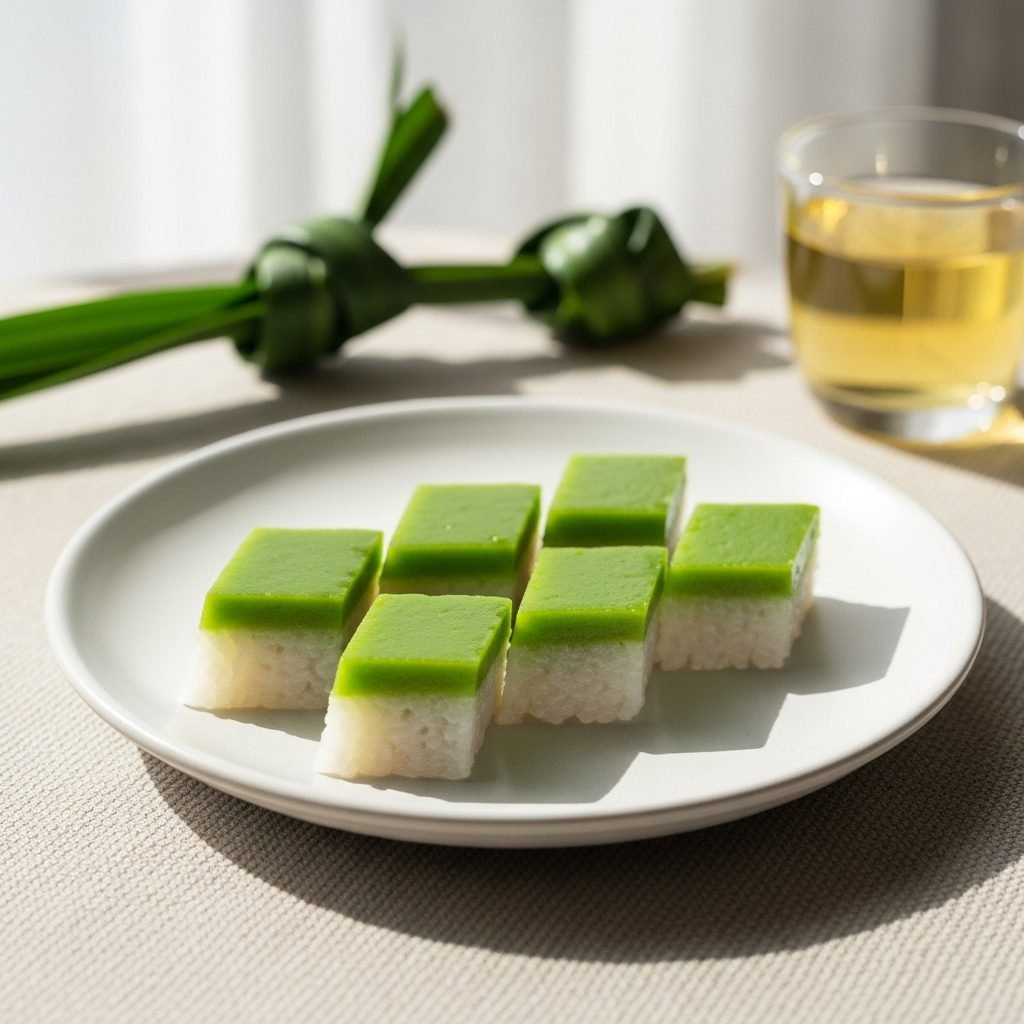
Dreamy Coconut Pandan Layer Cake (Kuih Seri Muka)
Kuih Seri Muka Recipe
Get ready to fall in love with Kuih Seri Muka, a classic Malaysian dessert that’s as beautiful as it is delicious! This stunning two-layered cake features a chewy, savory glutinous rice base topped with a silky, fragrant pandan coconut custard. It’s a delightful dance of textures and flavors that will transport you straight to a Southeast Asian paradise.
30 minutes (plus 4 hours rice soaking)
55 minutes
1 hour 25 minutes (plus 4 hours rice soaking)
16 squares (from an 8×8 inch pan)
Dessert
Steaming
Malaysian
Gluten-Free
Why You’ll Love This Recipe
- Chewy glutinous rice meets a silky-smooth coconut custard
- Naturally vibrant green from fresh pandan leaves
- A stunning and authentic Malaysian dessert experience
- Foolproof recipe for perfect layers every time
Equipment You’ll Need
- 8×8 inch square baking pan
- Large steamer with a lid (or a large wok with a steaming rack)
- High-speed blender
- Large mixing bowl
- Medium mixing bowl
- Whisk
- Fine-mesh sieve
- Spatula
- Parchment paper
Ingredients
- For the Glutinous Rice Layer:
- 1 2/3 cups (330g) glutinous rice, rinsed and soaked in water for at least 4 hours or overnight
- 2/3 cup (160ml) thick, full-fat coconut milk
- 1/3 cup (80ml) water
- 1/2 teaspoon salt
- 2 fresh pandan leaves, tied into a single knot
- For the Pandan Custard Layer:
- 1 cup packed (about 10-12) fresh pandan leaves, washed and cut into 1-inch pieces
- 1 cup (240ml) water
- 2 large eggs, at room temperature
- 3/4 cup (150g) granulated sugar
- 1 1/4 cups (300ml) thick, full-fat coconut milk
- 1/4 cup (30g) all-purpose flour (use a gluten-free blend for a fully GF dessert)
- 1/4 cup (30g) tapioca starch
- 1/4 teaspoon salt
- 1 drop green food coloring (optional, for a more vibrant color)
Instructions
- Prepare the Pan and Steamer: Lightly grease an 8×8 inch square pan and line it with parchment paper, leaving an overhang on two sides to easily lift the cake out later. Fill your steamer with water and bring it to a boil over medium-high heat.
- Cook the Glutinous Rice Layer: Drain the soaked glutinous rice completely. In a medium bowl, combine the drained rice, 2/3 cup coconut milk, 1/3 cup water, and 1/2 teaspoon salt. Stir well and pour into the prepared pan. Place the knotted pandan leaves on top of the rice.
- Steam the Rice: Place the pan in the preheated steamer. Steam for 20-25 minutes, or until the rice is fully cooked and translucent. Remove the pan from the steamer and discard the pandan knot.
- Press the Rice: While the rice is still hot, use the back of a spatula or spoon (lightly oiled to prevent sticking) to press the rice down firmly and evenly. This step is crucial for creating a compact base. Set aside while you prepare the custard.
- Make the Pandan Juice: In a blender, combine the chopped pandan leaves and 1 cup of water. Blend on high until the leaves are finely pulverized. Pour the mixture through a fine-mesh sieve lined with cheesecloth, pressing down on the pulp to extract as much vibrant green juice as possible. You should have about 3/4 cup of pandan juice.
- Prepare the Custard Mixture: In a large bowl, whisk the eggs and sugar together until the sugar is mostly dissolved. Add the pandan juice, 1 1/4 cups coconut milk, all-purpose flour, tapioca starch, and 1/4 teaspoon salt. Whisk until the mixture is completely smooth and free of lumps.
- Strain the Custard: For an ultra-smooth custard, strain the mixture through a fine-mesh sieve into another bowl to catch any remaining lumps. If using, stir in the optional green food coloring.
- Steam the Custard Layer: Gently pour the strained custard mixture over the pressed rice layer in the pan. Place the pan back into the steamer. Wrap the steamer lid with a clean kitchen towel to prevent condensation from dripping onto the custard.
- Steam until Set: Steam on medium-low heat for 30-35 minutes, or until the custard is set (it should have a slight jiggle in the center, like panna cotta).
- Cool Completely: Carefully remove the pan from the steamer and let it cool on a wire rack. It is essential to let the Kuih Seri Muka cool completely to room temperature, for at least 4-6 hours, before attempting to slice it. Do not refrigerate to speed up the process, as it can alter the texture.
- Slice and Serve: Once completely cool, use the parchment paper overhangs to lift the cake out of the pan. Use a plastic knife or an oiled sharp knife to cut it into squares or diamonds. Enjoy!
Expert Cooking Tips
- For the smoothest custard, strain the mixture twice. The first time to remove lumps from the flour, and a second time just before pouring it over the rice to eliminate any air bubbles.
- Wrap the steamer lid with a clean kitchen towel. This is a classic trick that absorbs condensation, preventing water from dripping onto your beautiful custard and creating pockmarks.
- When pressing the rice layer, be firm and thorough! A tightly compacted base is the secret to clean, distinct layers and prevents the green custard from seeping into the rice.
- Patience is key when cooling. Do not rush the cooling process. Cutting the kuih while it’s still warm will result in a messy, unset custard layer. Let it set fully at room temperature for the best results.
Substitutions and Variations
If you can’t find fresh pandan leaves, substitute with 1 teaspoon of high-quality pandan extract mixed into the custard. For the starches, cornstarch can replace tapioca starch in a 1:1 ratio, though the custard will be slightly less chewy. To ensure the entire dessert is gluten-free, simply use a certified gluten-free all-purpose flour blend in the custard layer, as the glutinous rice base is naturally gluten-free.
Common Mistakes to Avoid
A common pitfall is steaming at too high a heat, which can cause the egg custard to curdle and become lumpy. Maintain a gentle, steady steam. Another mistake is not pressing the rice layer down firmly enough, which allows the liquid custard to bleed into the rice, ruining the distinct layers. Finally, the biggest error is impatience; slicing the kuih before it has cooled completely for several hours will result in a gooey mess instead of clean, beautiful slices.
Serving Suggestions
Kuih Seri Muka is best enjoyed at room temperature as a delightful snack or light dessert. Its sweet, creamy profile pairs wonderfully with a cup of hot, unsweetened Malaysian ‘kopi o’ (black coffee) or a fragrant jasmine green tea to cleanse the palate and balance the richness.
Storage and Reheating Tips
Store any leftovers in an airtight container at room temperature for up to 2 days. If you need to store it longer, you can refrigerate it for up to 5 days. Note that refrigeration will cause the rice layer to harden. To restore its soft texture, allow it to come to room temperature for 30-40 minutes before serving, or steam individual pieces for 1-2 minutes until softened.
Nutrition Facts (Estimated)
| Serving Size | 1 square |
| Calories | 185 kcal |
| Fat | 8 g |
| Saturated Fat | 7 g |
| Unsaturated Fat | 1 g |
| Trans Fat | 0 g |
| Cholesterol | 30 mg |
| Sodium | 65 mg |
| Carbohydrates | 26 g |
| Fiber | 1 g |
| Sugar | 15 g |
| Protein | 2 g |
Frequently Asked Questions
Why is my custard layer lumpy or curdled?
This usually happens if the steaming temperature is too high. The intense heat causes the eggs in the custard to cook too quickly and curdle. Always steam on a gentle medium-low heat. Also, ensure you whisked the custard mixture until it was perfectly smooth and strained it before steaming.
Why did my green custard layer seep into the white rice layer?
This is almost always because the glutinous rice layer was not pressed down firmly enough. You need to create a very compact, sealed surface so the liquid custard sits neatly on top. Use the back of a spoon or a flat-bottomed glass to press it down tightly before pouring over the custard.
Can I use frozen pandan leaves?
Yes, absolutely! Frozen pandan leaves work very well. Just thaw them completely before cutting and blending them with water as instructed in the recipe. The flavor and color will be excellent.
Can I make this recipe vegan?
Unfortunately, creating a vegan version of Kuih Seri Muka is quite challenging as the eggs are essential for creating the specific texture of the set custard layer. Egg substitutes may not yield the same silky, firm-yet-jiggly result and are not recommended for this particular traditional recipe.
Conclusion
There you have it – a slice of Malaysian sunshine right in your kitchen! The aroma of pandan and coconut filling your home as this kuih steams is pure magic. We promise that the first bite, with its perfect balance of chewy rice and creamy custard, will make every step worthwhile. If you make this Dreamy Coconut Pandan Layer Cake, be sure to snap a photo and share it on Pinterest and Instagram, tagging us so we can see your beautiful creation!