Creamy Coconut Black Rice Pudding (Bubur Pulut Hitam)
Bubur Pulut Hitam Recipe
Get ready to fall in love with the most comforting dessert you’ve ever had. This Bubur Pulut Hitam recipe creates a dreamy, deep purple porridge with a nutty, slightly sweet flavor, all swimming in a luscious, salty-sweet coconut cream sauce. It’s a hug in a bowl that’s surprisingly simple to make and will transport you straight to a cozy kitchen in Southeast Asia.
15 minutes (plus 4 hours or overnight soaking)
45-60 minutes
Approximately 1 hour (plus soaking time)
6 servings
Dessert
Stovetop
Southeast Asian
Gluten-Free, Vegan
Why You’ll Love This Recipe
- Rich, nutty, and perfectly sweet
- Velvety smooth with a satisfying chew
- Naturally vegan and gluten-free
- A simple, one-pot dessert wonder
Equipment You’ll Need
- Large heavy-bottomed pot or Dutch oven
- Small saucepan
- Fine-mesh sieve
- Measuring cups and spoons
- Whisk
- Ladle
Ingredients
- 1 cup black glutinous rice (also called black sticky rice)
- 6 cups water, plus more if needed
- 2 pandan leaves, tied into a knot
- 1/2 cup chopped palm sugar (gula melaka), or substitute with dark brown sugar or coconut sugar
- 1/4 teaspoon fine sea salt
- For the Coconut Sauce:
- 1 can (13.5 oz) full-fat coconut milk
- 1 pandan leaf, tied into a knot (optional)
- 1/2 teaspoon fine sea salt
Instructions
- First, prepare the rice. Place the black glutinous rice in a fine-mesh sieve and rinse under cold running water until the water runs mostly clear. Transfer the rinsed rice to a large bowl and cover with at least 3 inches of cool water. Let it soak for at least 4 hours, or preferably overnight. This step is crucial for achieving a soft, tender texture.
- Once soaked, drain the rice thoroughly. Transfer the drained rice to a large, heavy-bottomed pot or Dutch oven.
- Add 6 cups of fresh water and the knotted pandan leaves to the pot with the rice. Bring the mixture to a boil over medium-high heat.
- Once boiling, reduce the heat to a medium-low simmer. Cover the pot partially, leaving a small gap for steam to escape, which prevents it from boiling over. Let it simmer gently for 45 to 60 minutes, stirring every 10-15 minutes to prevent the rice from sticking to the bottom of the pot.
- The porridge is ready when the rice grains are very soft, have burst open, and the mixture has thickened to a porridge-like consistency. If it becomes too thick before the rice is fully cooked, add another 1/2 to 1 cup of hot water as needed.
- Once the rice is tender, remove the pandan leaves. Stir in the chopped palm sugar and the 1/4 teaspoon of salt. Continue to simmer for another 5-10 minutes, stirring constantly, until the sugar is completely dissolved and the porridge is glossy and thick. The color will deepen to a beautiful dark purple.
- While the porridge finishes cooking, prepare the coconut sauce. In a separate small saucepan, combine the full-fat coconut milk, the optional pandan leaf, and the 1/2 teaspoon of salt.
- Warm the coconut milk mixture over medium-low heat, stirring gently. Heat just until it is warm and slightly thickened. Do not let it boil, as this can cause the coconut milk to curdle and separate. Once warmed through, remove from the heat and discard the pandan leaf.
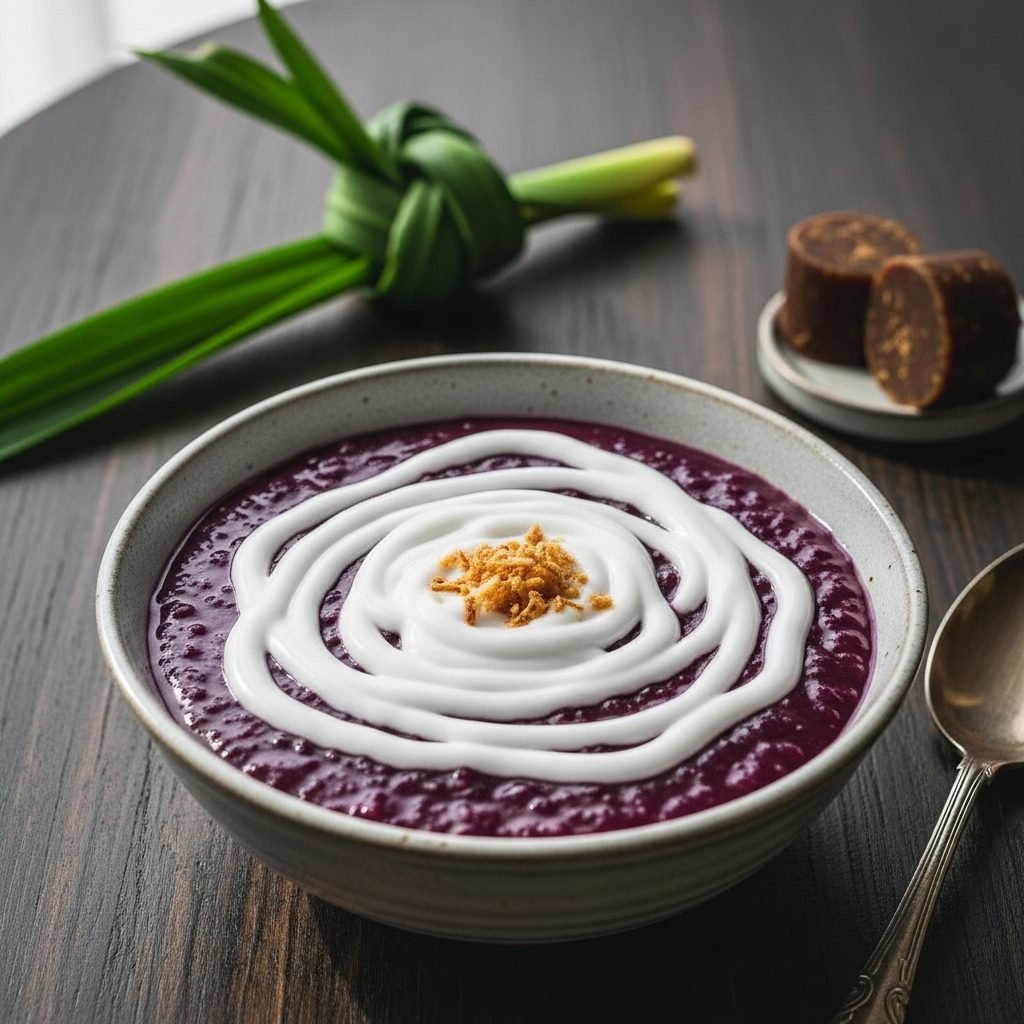
- To serve, ladle the warm black rice porridge into individual bowls. Drizzle a generous amount of the warm, salty coconut sauce over the top. Serve immediately and enjoy the delightful contrast of flavors and temperatures.
Expert Cooking Tips
- Don’t skip the soak! Soaking the rice is the most important step. It significantly reduces cooking time and ensures the grains cook evenly and become perfectly tender, not gritty.
- For a deeper, nuttier flavor, you can dry-toast the rinsed and drained glutinous rice in the pot for a few minutes over medium heat before adding the water. Stir constantly until it’s fragrant.
- Stir occasionally but not constantly. You need to stir enough to prevent sticking, but over-stirring can make the porridge gummy. A stir every 10-15 minutes during the simmer is usually perfect.
- Adjust sweetness to your liking. Palm sugar has a wonderful caramel, smoky flavor, but feel free to add more or less depending on your preference. Taste the porridge before serving and adjust if needed.
Substitutions and Variations
The star of this dish is black glutinous rice, which is distinct from regular black ‘forbidden’ rice and should not be substituted. For the sweetener, palm sugar (gula melaka) is traditional and offers a unique, complex flavor. If you can’t find it, dark brown sugar or coconut sugar are the best substitutes. You can use light brown sugar, but you’ll miss some of the deep, molasses notes. If you don’t have pandan leaves, you can omit them or add a 1/4 teaspoon of vanilla extract to the porridge and the coconut sauce after cooking, though the flavor will be different. For a lower-fat version, you can use light coconut milk for the sauce, but it won’t be as rich or creamy.
Common Mistakes to Avoid
The most common mistake is undercooking the rice, resulting in a gritty, hard texture. Be patient and let it simmer until the grains are completely soft and have split open. Test a few grains before adding the sugar. Another frequent error is adding the sugar too early in the cooking process; this can cause the rice grains to harden and prevent them from cooking through. Always wait until the rice is fully tender before stirring in the sugar. Finally, be careful not to boil the coconut sauce. Boiling full-fat coconut milk can cause it to separate and become oily or curdled. Gentle heating is all that’s needed to warm it through and thicken it slightly.
Serving Suggestions
Bubur Pulut Hitam is traditionally served warm, with the salty coconut sauce creating a beautiful marbled effect on the dark porridge. For extra texture and flavor, garnish with toasted coconut flakes, a sprinkle of toasted sesame seeds, or slices of fresh tropical fruit like mango, banana, or jackfruit. While it’s most often enjoyed as a dessert, it’s also a popular breakfast or teatime snack in Southeast Asia. It can also be served chilled on a hot day for a refreshing treat.
Storage and Reheating Tips
Store any leftover porridge and coconut sauce in separate airtight containers in the refrigerator for up to 4 days. The porridge will thicken considerably as it cools. To reheat, place the desired amount of porridge in a saucepan over low heat and add a splash of water or coconut milk to loosen it to your desired consistency. Reheat the coconut sauce gently in a separate saucepan or in the microwave, being careful not to boil it.
Nutrition Facts (Estimated)
| Serving Size | 1 bowl (approx. 1 cup) |
| Calories | 385 kcal |
| Fat | 16 g |
| Saturated Fat | 13 g |
| Unsaturated Fat | 1.5 g |
| Trans Fat | 0 g |
| Cholesterol | 0 mg |
| Sodium | 210 mg |
| Carbohydrates | 58 g |
| Fiber | 5 g |
| Sugar | 24 g |
| Protein | 7 g |
Frequently Asked Questions
Is black glutinous rice the same as black ‘forbidden’ rice?
No, they are different! Black glutinous rice (or black sticky rice) is a type of glutinous rice that becomes sticky and soft when cooked, perfect for desserts. Black ‘forbidden’ rice is a non-glutinous, medium-grain rice that cooks up fluffier and is better suited for savory dishes. Make sure you use black glutinous rice for this recipe to get the correct creamy, chewy texture.
Why are my rice grains still tough after an hour of cooking?
This usually happens for two reasons. First, the rice may not have been soaked long enough. An overnight soak is best for ensuring the grains are fully hydrated. Second, you might have added the sugar too early. Sugar can hinder the rice’s ability to absorb water and soften. Always cook the rice until it’s completely tender before you add any sweetener.
What are pandan leaves, and are they necessary?
Pandan leaves are long, green leaves used widely in Southeast Asian cooking. They impart a wonderfully fragrant, sweet, and slightly grassy aroma that is iconic to many desserts. While you can make the porridge without them, you will miss out on that authentic flavor. If you can’t find them at your local Asian market (fresh or frozen), you can substitute with a tiny splash of vanilla extract, but the taste won’t be the same.
Can I make this in an Instant Pot or pressure cooker?
Yes, you can! After soaking and draining the rice, combine it with 4 cups of water and the pandan leaves in the Instant Pot. Cook on high pressure for 20-25 minutes, followed by a 15-minute natural pressure release. Release any remaining pressure, remove the lid, stir in the sugar and salt, and use the ‘Sauté’ function for a few minutes to dissolve the sugar and thicken the porridge further.
Conclusion
There you have it—a simple yet profoundly delicious Bubur Pulut Hitam that brings a taste of Southeast Asian comfort right to your kitchen. The balance of the nutty, sweet porridge and the rich, salty coconut cream is truly a match made in heaven. I hope you adore this recipe as much as I do. If you try it, I’d love to see your creation! Tag me on social media and share a photo of your beautiful bowl of black rice pudding.