That Shiny Shell & Ruffled ‘Foot’: A No-Fear Guide to Making Chocolate Macarons
Let’s just get this out of the way: macarons are intimidating. We’ve all seen the Pinterest fails. The cracked, volcano-like tops. The sad, flat cookies with no “feet.” The dreaded hollow insides. They have a reputation for being the most finicky, dramatic, and downright difficult cookie in the world.
And honestly… they kind of are.
But here’s the good news: they are not impossible. They aren’t magic. They are simply a science. And once you understand the why behind each step, the whole process becomes a fun, rewarding challenge instead of a terrifying one.
This is your weekend baking project. This is your guide. We are going to walk through every single crucial step, from sifting (and sifting again) to the all-important “macaronage,” to finally achieve that iconic, delicate cookie.
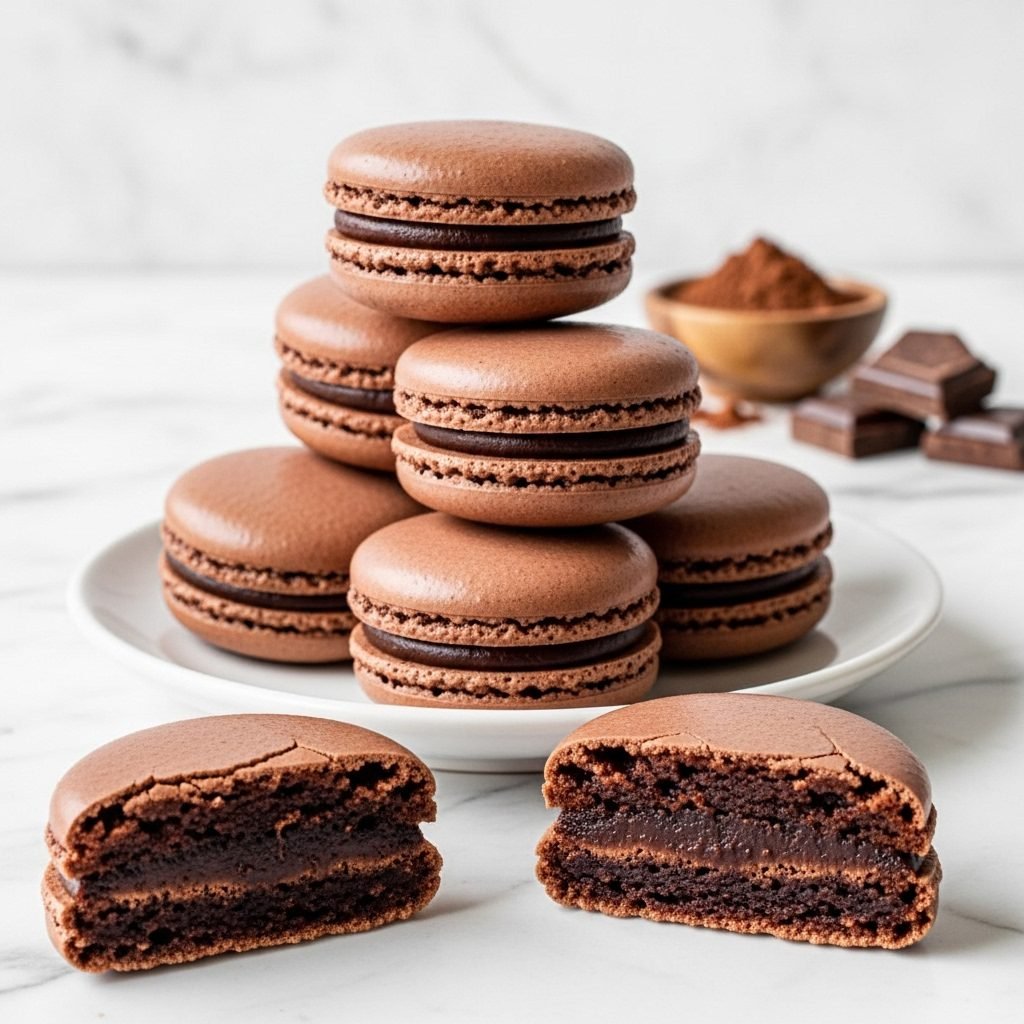
The feeling of biting into a homemade chocolate macaron that you made—that crisp, paper-thin shell that gives way to a chewy, almond-cocoa center, all held together by a rich, dark chocolate ganache—is unlike anything else. You can do this. So, take a deep breath, put on your apron, and let’s make some macarons.
What to Expect from This Recipe
- The Flavor: Deep, rich, dark chocolate. The cocoa in the shell and the ganache filling create a full, rounded chocolate experience, balanced by the nutty, sweet almond.
- The Texture: This is everything. A delicate, crisp outer shell, a wonderfully chewy and moist interior, and a smooth, creamy ganache center.
- Difficulty: I won’t lie to you: this is an advanced recipe. Not because any single step is hard, but because it demands precision, patience, and following the instructions to the letter. It is a rewarding challenge!
- What Makes It Special: This is the French Meringue method, which is the most straightforward for beginners (no hot sugar syrup!). The entire focus is on the technique, especially the “macaronage,” which creates the signature shell and “feet.”
Ingredients You’ll Need (Precision is Everything)
This is the most important part of the recipe. You must use a kitchen scale. Macarons are a science of ratios. Measuring by “cups” is too inaccurate and is the #1 reason for macaron failure. I’ve included cup measurements for reference, but I am begging you to use the grams.
For the Chocolate Ganache Filling (Make This First):
- 4 oz (113g) good-quality bittersweet chocolate (at least 60%, chopped)
- ½ cup (120ml) heavy cream
For the Chocolate Macaron Shells:
- 1 ¼ cups (120g) super-fine almond flour
- ¾ cup (100g) powdered sugar
- 2 tbsp (15g) unsweetened Dutch-process cocoa powder
- 3 large egg whites (about 100g), at room temperature
- A pinch of cream of tartar
- ½ cup (100g) granulated sugar
The Step-by-Step Method to Macaron Success
Take this one section at a time. Read the entire section before you start it.
Part 1: Make the Ganache (So It Can Chill)
- Place your chopped chocolate in a medium, heat-proof bowl.
- Pour the heavy cream into a small saucepan. Heat it over medium-low heat just until it begins to simmer (tiny bubbles form around the edges). Don’t let it boil.
- Pour the hot cream directly over the chopped chocolate. Let it sit, untouched, for 5 minutes. This melts the chocolate gently.
- After 5 minutes, start stirring with a small whisk, beginning in the very center and working your way out in concentric circles. It will look like a mess at first, but suddenly it will come together into a smooth, glossy ganache.
- Press a piece of plastic wrap directly onto the surface of the ganache (to prevent a “skin” from forming) and place it in the refrigerator to chill and thicken for at least an hour, or until it’s a “pipeable” peanut-butter consistency.
Part 2: Prepare the Macaron Shells
- Prep Your Station: Line two large baking sheets with parchment paper. If you’re new to this, it helps to trace 1.5-inch circles on the underside of the parchment as a guide, leaving 2 inches between them. Set aside a large piping bag fitted with a ½-inch round tip.
- SIFT. SIFT. SIFT. This is non-negotiable for smooth tops. Get a large bowl and a fine-mesh sieve. Add your almond flour, powdered sugar, and cocoa powder to the sieve. Sift them all together into the bowl. You’ll be left with some lumpy almond bits—just discard them.
- SIFT AGAIN. Yes, I’m serious. Pour that mixture back into the sieve and sift it a second time. This is the secret to a high-gloss, smooth shell. Set this dry mixture aside.
- Make the Meringue: Place your 100g of room-temperature egg whites in the spotlessly clean, grease-free bowl of a stand mixer (or a large glass/metal bowl if using a hand mixer). Add the pinch of cream of tartar.
- Whip on medium-low speed until the whites are foamy, like a bubble bath.
- Turn the speed to medium. Start adding your 100g of granulated sugar, one tablespoon at a time, very slowly, waiting about 30 seconds between additions. This slow addition is key to a stable meringue.
- Once all the sugar is added, turn the mixer speed up to medium-high. Whip for 5-8 minutes, until the meringue is incredibly thick, glossy, and forms stiff peaks. This means when you pull the whisk out, a peak forms and stands straight up, perhaps with a tiny curl at the end (a “bird’s beak”). If you turn the bowl upside down, nothing should move.
Part 3: The “Macaronage” (The Most Important Step)
This is the process of folding the dry ingredients into the meringue. It is where you either make or break your macarons.
- Add about ⅓ of your sifted dry ingredients to the meringue. Using a spatula, gently fold them in. Use a “scrape and fold” motion—scrape around the edge of the bowl, then fold the batter over the top. Turn the bowl a quarter turn and repeat.
- Add the second ⅓ of the dry ingredients and continue to fold gently until it’s just combined.
- Add the final ⅓ of the dry ingredients. Now, your technique changes. Continue folding, but start to be a bit more “firm.” Scrape the batter against the side of the bowl as you fold. You are intentionally deflating some of the air.
- The “Lava Test”: This is how you know it’s ready. Lift your spatula and let the batter fall back into the bowl. It should fall in a thick, continuous, “molten lava” ribbon, and you should be able to “draw” a figure-8 with the ribbon without it breaking.
- The “10-Second Test”: The ribbon of batter that fell into the bowl should slowly dissolve back into the surface in about 10-15 seconds.
- If it’s lumpy and doesn’t flow: It’s under-mixed. Fold a few more times.
- If it’s thin and watery: It’s over-mixed. Sadly, there is no saving it. (This batter can be baked as flat cookies, but it won’t make macarons).
- As soon as you hit the “lava” stage, STOP.
Part 4: Piping, Whacking, and Resting
- Transfer your macaron batter to the prepared piping bag.
- Hold the bag straight up and down (perpendicular to the pan) and pipe your 1.5-inch circles, using your template if you have one. Stop squeezing just before the circle is full, and flick the tip of the bag in a “C” motion to finish.
- WHACK THE TRAYS. This is not a suggestion. Pick up one baking sheet and rap it hard on your counter 5-6 times. Rotate it and do it again. This forces any large, hidden air bubbles to the surface. (If you see any bubbles, pop them with a toothpick).
- THE REST. This is the second non-negotiable step. Let the trays of piped macarons sit at room temperature for 30-60 minutes, or until they form a “skin.”
- The “Touch Test”: They are ready to bake when you can gently touch the top of a macaron, and it’s dry, matte, and not sticky. Your finger should come away clean. This skin is what forces the macaron to bake up and create “feet.”
Part 5: Baking and Maturing
- While the shells rest, preheat your oven to 300°F (150°C). (Note: every oven is different. You may need to adjust this on future batches).
- Bake one tray at a time on the middle rack for 15-18 minutes.
- The “Wiggle Test”: They are done when the tops are firm and set. Gently nudge the top of one shell. If the “foot” wiggles or slides around, they need 1-2 more minutes. The top should be firm on its foot.
- Let the shells cool completely on the baking sheet before you even think about peeling them off the parchment.
Part 6: Assembly and Maturation (The Final Secret)
- Gently peel your cooled shells off the parchment. Match them up into pairs by size.
- Transfer your chilled, thickened ganache to a piping bag. Pipe a dollop of ganache onto the flat side of one shell. Gently press a second shell on top, twisting slightly to spread the ganache to the edge.
- THE MOST IMPORTANT STEP FOR TEXTURE: Place your filled macarons in an airtight container and put them in the refrigerator for 24 hours. This is called “maturing.” The ganache’s moisture seeps into the shells, transforming them from “crispy” to “chewy.” Do not skip this.
My Top Tips for Macaron Success
- USE A SCALE. I’m saying it again. This is a 1:1 ratio of egg whites to granulated sugar, and roughly a 1.2:1 ratio of almond flour to egg whites. Cups will not work.
- SIFT. SIFT. SIFT. This is the secret to those smooth, glossy tops.
- A SPOTLESS BOWL. Any fat (yolk, grease) will kill your meringue. Wipe your bowl and whisk with white vinegar to be 100% sure.
- RESPECT THE MACARONAGE. Watch a video of it if you need to. It’s a “feel” you will learn. Under-mixed is better than over-mixed.
- THE WHACK & REST. Mandatory. These two steps release air and form the skin that creates the feet.
- KNOW THY OVEN. An oven thermometer is your best friend. Most home ovens are lying about their temperature.
- PATIENCE. Do not take them off the pan hot. Do not eat them right away. Let them cool. Let them mature.
Substitutions (Spoiler: Not Many)
- Almond Flour: You must use super-fine, blanched almond flour. Do not use “almond meal,” which is coarse and has skins.
- Cream of Tartar: You can substitute 1 tsp of white vinegar or lemon juice for the pinch of cream of tartar. It’s just a stabilizer for the meringue.
- Gluten-Free: This recipe is naturally 100% gluten-free!
- Dairy-Free: The shells are dairy-free. For the ganache, use a good-quality dairy-free chocolate and substitute the heavy cream with an equal amount of full-fat canned coconut cream (the thick white part only).
Common Mistakes to Avoid (A Troubleshooting Guide)
- Why do my macarons have NO “FEET”?
- Your batter was over-mixed (too thin), or you didn’t let them rest long enough to form a dry skin.
- Why did my macarons CRACK on top?
- Your batter was under-mixed (too thick), you didn’t “whack” the air bubbles out, or your oven was too hot.
- Why are my macarons HOLLOW?
- Your meringue was under-whipped (not stiff enough), your oven was too low, or you over-mixed the batter. This is the trickiest problem!
- Why are my shells WRINKLY?
- Your almond flour was too oily, or grease got into your meringue.
- Why did they spread out and get FLAT?
- Your batter was way over-mixed.
- Why are they STICKY and CHEWY (not crisp)?
- You under-baked them, or it’s a very humid day. Try to make macarons on a dry day!
Serving and Storing Your Masterpieces
- Serving: Always let your macarons come to room temperature for 20-30 minutes before serving. The ganache will soften, and the shell will have the right texture.
- Storage: Store the filled, mature macarons in an airtight container in the refrigerator for 3-5 days.
- Freezing: Macarons freeze beautifully. Place the mature macarons in a single layer in an airtight container and freeze for up to 3 months. Let them thaw in the fridge for a few hours, then bring to room temp before eating.
Your Macaron Questions, Answered
- What are “aged” egg whites?
- This is a common macaron tip. It just means letting your egg whites sit, covered, in the fridge for 24 hours to “dehydrate” them. Honestly? I find that room-temperature egg whites work just as well, as long as you have a stable meringue.
- Can I use a different filling?
- Absolutely. Chocolate buttercream, jam, or lemon curd are all great. Just make sure the filling is thick and not too “wet.”
- Can I reduce the sugar?
- No. In macarons, sugar is a structural ingredient, not just a sweetener. It’s what creates the shell, the chew, and the stability. The recipe will fail if you reduce the sugar.
A Rewarding, Delicious Challenge
Macarons are a journey. Your first batch might not be window-display-ready. But they will still be delicious (it’s hard to mess up almond, cocoa, and sugar!). Don’t be discouraged. Every batch teaches you something. You’ll learn what “lava” looks like. You’ll get a feel for your oven. And when you pull that first tray of shiny, full-footed shells from the oven, you will feel like a true pâtissier.
Recipe Summary
This is a detailed, step-by-step guide to making classic French chocolate macarons. The recipe focuses on the French meringue method and breaks down the most critical techniques, including sifting, creating a stable meringue, and mastering the “macaronage” (folding). The shells are filled with a simple, rich chocolate ganache and “matured” in the refrigerator for 24 hours to develop their signature chewy texture.
You Did It! Share Your Bake!
If you take on this challenge, I need to see it! Did you get feet? What did you learn? Tag me on social media [Your Social Handle Here] or leave a comment below. And if this guide helped you, please Pin this recipe to help other aspiring macaron bakers!
Happy baking!