The Showstopping “Crown of Cream Puffs”: A (Doable!) Gateau St. Honoré Recipe
If there is one dessert that is the “final boss” of the baking world, this is it. The Gâteau St. Honoré. It is the pastry that patisseries are judged on, a true icon of French baking, and it’s named after the patron saint of pastry chefs.
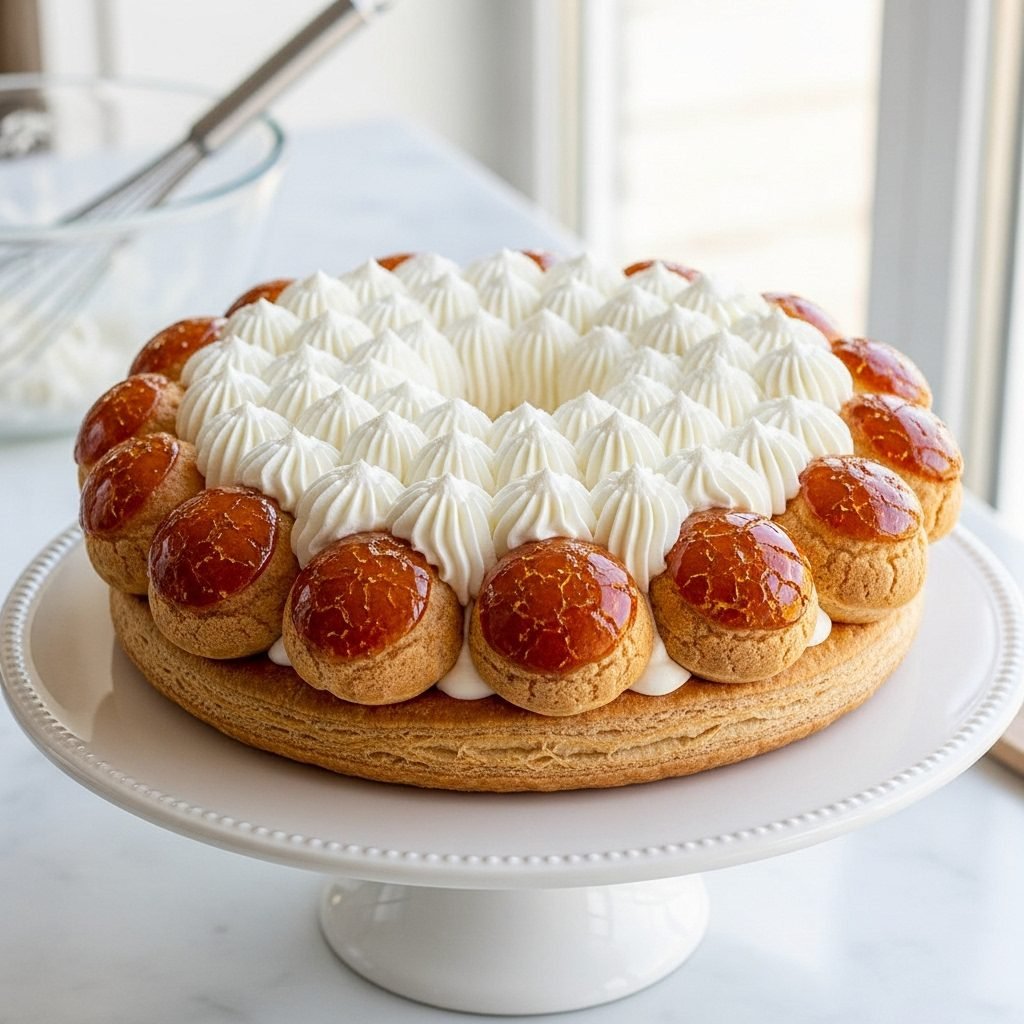
It’s easy to see why. It’s a stunning piece of architecture. It’s a crisp, golden puff pastry base, crowned with a ring of delicate, caramel-dipped cream puffs. The center is then filled with a cloud of the most ethereal, light-as-air cream, piped in a beautiful, dramatic pattern.
I know what you’re thinking: “This is impossible.” It looks like something that requires years of training and a kitchen full of special equipment.
I’m going to let you in on a secret: it’s not a single, terrifyingly difficult task. It’s a series of simple, easy steps that just happen to add up to a showstopper.
This is, without a doubt, a “project bake.” It is a labor of love. It is not a quick Tuesday-night dessert. But if you have a special occasion, a birthday, an anniversary, or just a weekend where you want to lose yourself in the kitchen and create something truly magnificent, this is the recipe.
I will walk you through every single component. We will use a smart shortcut for the base, a stable method for the cream, and a safe way to handle the caramel. You can do this. And when you place this “crown of cream puffs” on the table, you will feel like a true pâtissier.
What Makes This Gateau So Special
- The Flavor: This is a dessert all about balance. It’s not just sweet. You get the deep, toasty-bitter notes of the hard caramel, the rich, silky vanilla-bean-scented cream, and the savory, buttery flavor of the flaky pastry. It’s sophisticated and incredibly satisfying.
- The Texture: This is the best part. It’s a symphony of textures: the shattering, crackly caramel shell on the puffs, the airy, light choux pastry, the creamy, velvety, cloud-like center filling, and the crisp, flaky puff pastry base.
- The Time: This is an all-day affair, but it’s 90% “wait time.” It requires about 2-3 hours of active kitchen time, but the components must be baked and cooled. It’s a true “assembly” dessert.
- The Difficulty: I’ll be honest, this is an “advanced” bake. Not because any single step is hard, but because it has many components. It requires organization and patience. But this recipe is designed to be as “beginner-friendly” as an advanced pastry can be.
Your Ingredient Shopping List
A Gâteau St. Honoré is an assembly of four main components. Let’s break it down.
1. For the Pastry Base (The Shortcut!)
- 1 sheet (about 9-10 oz) all-butter, store-bought puff pastry, thawed in the fridge
2. For the Choux Pastry (The Cream Puffs)
- 1/2 cup (120ml) water
- 1/2 cup (120ml) whole milk
- 1/2 cup (1 stick / 113g) unsalted butter, cut into cubes
- 1 tsp granulated sugar
- 1/4 tsp salt
- 1 cup (125g) all-purpose flour
- 4-5 large eggs, at room temperature
3. For the Diplomat Cream (The Filling)
- 2 cups (480ml) whole milk
- 1 vanilla bean, split and scraped (or 2 tsp vanilla extract)
- 6 large egg yolks
- 3/4 cup (150g) granulated sugar
- 1/2 cup (60g) cornstarch
- 4 tbsp (1/2 stick / 57g) unsalted butter, cold
- 1 1/2 cups (360ml) cold heavy whipping cream
- 2 tbsp powdered sugar
4. For the Caramel (The “Glue”)
- 2 cups (400g) granulated sugar
- 1/2 cup (120ml) water
- 2 tbsp light corn syrup (This is the secret to stop it from crystallizing!)
How to Make a Gâteau St. Honoré, Step by Step
This is a lesson in workflow. We will make the components first, then assemble.
Part 1: Make the Pastry Cream (The Filling Base)
You must do this step first, as it needs to chill for at least 4 hours.
- Infuse Milk: In a medium saucepan, combine the 2 cups of milk and the scraped vanilla bean seeds (and the pod itself). Heat over medium heat until it’s just simmering. Turn off the heat, cover, and let it steep for 30 minutes.
- Make Slurry: In a large, heatproof bowl, whisk the 6 egg yolks and 3/4 cup of sugar for 2 minutes, until pale. Sift in the 1/2 cup of cornstarch and whisk until no lumps remain.
- Temper: Re-warm the milk. Fish out the vanilla pod. Very slowly, while whisking the yolk mixture constantly, pour about half of the hot milk into the yolks.
- Cook the Custard: Pour the tempered yolk mixture back into the saucepan. Return to medium heat. Whisk constantly and vigorously for 3-5 minutes. It will thicken. Once it starts to bubble, keep whisking for 1-2 full minutes to cook out the cornstarch taste.
- Finish: Remove from the heat. Whisk in the 4 tbsp of cold butter until it’s melted and smooth.
- Strain & Chill: This is the secret! Pour the custard through a fine-mesh sieve into a clean, shallow bowl. Press a piece of plastic wrap directly onto the surface of the custard to prevent a skin.
- Chill in the refrigerator for at least 4 hours, or overnight. It must be completely cold.
Part 2: Bake the Base & the Puffs
- Prep: Preheat your oven to 400°F (200°C). Line two large baking sheets with parchment paper.
- The Base: Unfold your thawed puff pastry sheet. Use a 9-inch round cake pan as a guide to cut out a perfect circle. Place this circle on one of the prepared baking sheets. Dock it all over with a fork (poke 50-60 holes in it). This stops it from puffing up.
- Bake the Base: Bake for 15-20 minutes, or until it’s golden-brown, crisp, and flat. Let it cool on a wire rack.
- Make the Choux Pastry: While the base bakes, make the puffs. In a medium saucepan, combine the water, milk, butter, 1 tsp sugar, and salt. Bring to a rolling boil over medium-high heat.
- The “Dough”: As soon as it boils, remove it from the heat and dump in all 1 cup of flour at once. Stir vigorously with a wooden spoon.
- Cook the Dough: Return the pan to medium heat and stir constantly for 2-3 minutes. The dough will form a ball and pull away from the sides. A “film” will form on the bottom of the pan. This is how you know it’s ready.
- Cool Slightly: Transfer the hot dough ball to the bowl of your stand mixer (with the paddle attachment) or a large bowl (for a hand mixer). Let it sit for 5-10 minutes to cool down so it doesn’t scramble the eggs.
- Add Eggs: Turn the mixer on low. Add 4 of the eggs, one at a time. This is the most important part. Wait until each egg is completely incorporated before adding the next. The dough will look “broken” and then come back together.
- Check Consistency: After 4 eggs, stop the mixer. Lift the paddle. The dough should be smooth, glossy, and when it falls, it should form a “V” shape that holds for a few seconds. If it’s too stiff, lightly beat the 5th egg in a small bowl and add half of it. Mix and check again. You may not need all 5 eggs.
- Pipe the Puffs: Transfer the choux paste to a piping bag with a 1/2-inch round tip. On your second baking sheet, pipe small, 1-inch mounds (like Hershey’s Kisses), about 2 inches apart. You should get 15-20 puffs. (You only need 10-12 for the crown, but extras are a good insurance policy!)
- Bake the Puffs: Bake at 400°F for 15 minutes, then, without opening the oven, reduce the heat to 350°F and bake for another 15-20 minutes. They should be deep golden-brown, light, and feel hollow.
- Let them cool completely on a wire rack.
Part 3: Make the Diplomat Cream (The Final Filling)
- Take your completely cold pastry cream from the fridge. Scrape it into a large bowl and whisk it vigorously until it’s smooth.
- In a separate, cold bowl, whip the 1 1/2 cups of cold heavy cream and 2 tbsp of powdered sugar until it holds stiff peaks.
- Lighten: Gently fold about one-third of the whipped cream into the pastry cream to lighten it.
- Fold: Add the rest of the whipped cream and fold gently until it’s all one color and no streaks remain. You now have a light, airy, pipe-able Diplomat Cream.
- Transfer this cream to a piping bag fitted with a star tip (like a St. Honoré tip, or a large open-star tip).
Part 4: The Final, Dazzling Assembly
- Fill the Puffs: Use a small piping tip (or just a skewer) to poke a small hole in the bottom of each of your 10-12 cooled cream puffs. Pipe the Diplomat Cream into each puff until it feels heavy. Set them aside.
- Prep for Caramel (SAFETY FIRST!): This is molten sugar. It is hotter than boiling water and will cause severe burns. Be careful, work focused, and do not let children help. Have a bowl of ice water nearby just in case.
- Make Caramel: In a clean, heavy-bottomed saucepan, combine the 2 cups of sugar, 1/2 cup of water, and 2 tbsp of corn syrup. Stir gently once before turning on the heat.
- Cook on medium-high heat, without stirring (just swirl the pan if you need to), until the mixture turns a deep, amber, copper-penny color. This takes 8-10 minutes.
- Stop the Cooking: As soon as it’s the right color, remove it from the heat and dip the bottom of the pan very carefully into your bowl of ice water for 3 seconds. This stops the cooking.
- WORK FAST: Your caramel will harden quickly.
- Dip the Puffs: Hold one filled cream puff by its sides. Dip the top (the domed side) into the hot caramel. Lift it out, let the excess drip off, and place it caramel-side-up on a silicone mat or lightly oiled parchment to harden. Repeat for all 10-12 puffs.
- Glue the Crown: Place your flat, cooled puff pastry base on your final serving platter. Now, dip the bottom (the flat, cream-filled side) of one of the hardened-top cream puffs into the still-warm caramel. This is your “glue.”
- Press it firmly onto the outer edge of the puff pastry base.
- Repeat with the rest of your puffs, “gluing” them side-by-side, until you have a beautiful crown all around the edge.
- Fill the Center: Take your piping bag of Diplomat Cream. Pipe it into the center of the ring, in any pattern you like—a large swirl, or (traditionally) in neat, vertical, back-and-forth lines.
Helpful Cooking Tips
- The “Shortcut”: Using store-bought, all-butter puff pastry is a huge time-saver and it’s what most modern bakeries do. No shame!
- The “V” Shape: The “V-shape” test for your choux paste is the most important step. If the batter drops in a “clump,” you need more egg. If it’s thin and runny, you’ve gone too far.
- Caramel Safety: I’m saying it again. Be careful. The corn syrup is your insurance policy against the sugar crystallizing.
- Work Fast: Assemble the moment your caramel is ready. If it starts to harden, you can very gently re-warm it on the stove, but be careful not to burn it.
Ingredient Substitutions
- The Liqueur: This is a classic addition. Add 2 tablespoons of Grand Marnier (orange) or Kirsch (cherry) to your pastry cream after it comes off the heat for a grown-up version.
- The Cream: A true, old-school Gâteau St. Honoré uses Crème Chiboust, which is pastry cream lightened with a hot, Italian meringue. It’s much more stable, but also much more advanced. Diplomat Cream is a delicious, accessible, and very common substitution.
Common Mistakes (and How to Avoid Them)
- “My Puffs are Flat!” You opened the oven door, or you didn’t bake them long enough. They must be deep golden-brown and feel light.
- “My Pastry Cream is Runny!” You didn’t cook it long enough. You must let it boil for 1-2 minutes while whisking to activate the cornstarch.
- “My Caramel is Grainy!” You either stirred it while it was boiling or you didn’t use corn syrup. The corn syrup is a “doctor” that stops sugar crystals from forming.
- “My Cake is a Soggy Mess.” This dessert must be served the day it is made. The caramel will absorb moisture from the air and the cream, and it will start to “weep” and get sticky after 4-5 hours.
How to Serve and Store
- Serving: This is the centerpiece. It needs nothing else. You bring it to the table whole. To serve, use a sharp, serrated knife. You need to crack through the hard caramel shell.
- Storage (The Sad Truth): This dessert does not store well. It is a “day-of” creation. You must assemble it within 3-4 hours of serving. The hard caramel is the enemy of moisture, and it will turn into a sticky, weepy, liquid after about 5 hours in the fridge.
- Make-Ahead Plan (The ONLY Way):
- Day 1: Make the pastry cream (chill it). Bake the puff pastry base (store airtight at room temp). Bake the choux puffs (store airtight at room temp).
- Day 2 (Serving Day): Make the Diplomat Cream. Fill the puffs. Make the caramel. Assemble the entire cake no more than 4 hours before you plan to serve it. Store it in the fridge.
Your Gâteau St. Honoré Questions
This looks terrifying. Can I really make it? Yes. Look at the steps. Can you make pudding from a box? You can make pastry cream. Can you boil water and stir in flour? You can make choux. Can you dip things in melted sugar? You can do this. It’s just a sequence of simple tasks.
Can I skip the caramel? You could, and just pile the cream-filled puffs on the base. But the hard, crackly caramel is the entire point. It’s the signature texture. I say, be brave and try it!
Can I fill the center with something else? Yes! A pile of fresh, macerated raspberries would be a stunning (and faster) filling.
A True Labor of Love
This is not a cake. This is a statement. It’s a true celebration dessert, and it’s one of the most rewarding, impressive things you will ever pull out of your kitchen.
When you crack through that caramel-shell, into the light puff, and hit that cloud of cold cream… you’ll know that every single second was worth it. You’ve earned this.
A Quick Summary
This “doable” recipe for the classic Gâteau St. Honoré guides you through its four main components: a crisp puff pastry base, airy choux pastry puffs, a silky vanilla diplomat cream, and a crackly, hard-caramel topping. The recipe breaks down each step, from making the pastry cream to filling the puffs and “gluing” them into a crown with molten caramel, making an advanced French pastry accessible to the ambitious home baker.