Dreamy Melt-in-Your-Mouth Coconut Cookies (Kuih Bangkit)
Kuih Bangkit Recipe
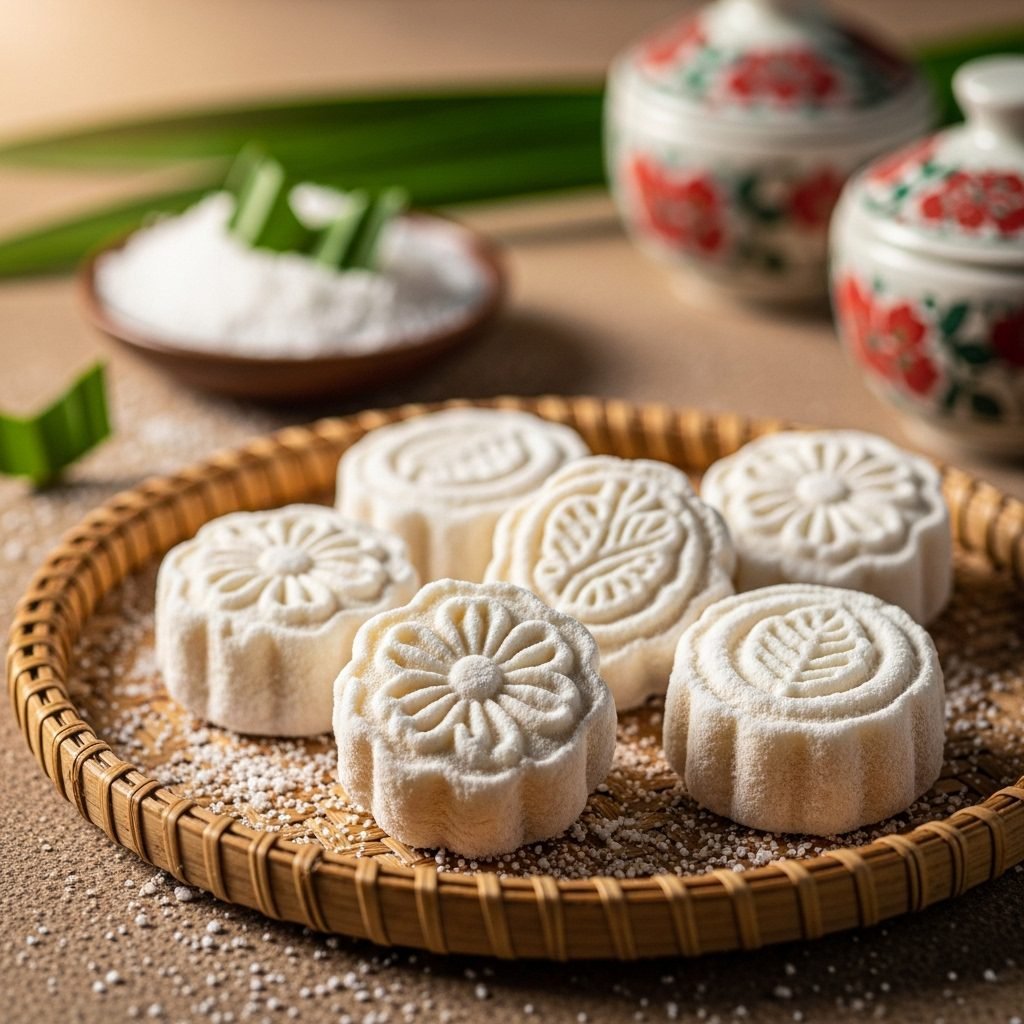
Get ready to fall in love with the lightest, most delicate cookie you’ve ever tasted! These Kuih Bangkit, or coconut cream cookies, have a magical melt-in-your-mouth texture that’s simply unforgettable. With a subtle sweetness and a rich coconut flavor, they are the perfect little treat to enjoy with a cup of tea.
30 minutes (plus 2 hours cooling time for flour)
15-20 minutes
2 hours 50 minutes
Approximately 80-100 small cookies
Dessert
Baking
Malaysian
Gluten-Free
Why You’ll Love This Recipe
- Incredibly light, airy, and melts in your mouth
- Naturally gluten-free and dairy-free
- Made with just a few simple pantry ingredients
- A beautiful and unique cookie for holidays and special occasions
Equipment You’ll Need
- Large Wok or Pan
- Spatula
- Sifter or Fine-Mesh Sieve
- Stand Mixer or Hand Mixer with a large bowl
- Rolling Pin
- Kuih Bangkit Molds or Small Cookie Cutters
- Baking Sheets
- Parchment Paper
Ingredients
- 4 cups tapioca starch (also known as tapioca flour)
- 4-5 pandan leaves, cut into 2-inch pieces (optional, for fragrance)
- 1 cup thick coconut cream, chilled (from a can of full-fat coconut milk)
- 2 large egg yolks, at room temperature
- 1 cup powdered sugar, sifted
- 1/4 teaspoon salt
- Red food coloring (for decoration, optional)
Instructions
- First, prepare the flour. Place the tapioca starch and pandan leaves in a large, dry wok or pan. Stir continuously over low heat for about 15-20 minutes. The flour should become very light, airy, and fragrant. To test if it’s ready, it should feel light as air and not stick to your fingers. Discard the pandan leaves.
- Sift the toasted flour into a large bowl and let it cool completely to room temperature. This is a crucial step and will take at least 2 hours. Do not proceed with warm flour.
- In the bowl of a stand mixer fitted with the paddle attachment (or using a hand mixer), beat the egg yolks and sifted powdered sugar on medium-high speed until the mixture is pale, thick, and creamy, about 3-4 minutes.
- Reduce the mixer speed to low and slowly drizzle in the chilled thick coconut cream and salt. Mix until just combined.
- Gradually add the completely cooled, sifted tapioca starch to the wet mixture, one cup at a time, mixing on low speed until a dough begins to form. The dough will look crumbly at first.
- Turn the dough out onto a clean surface and gently knead it for a minute or two until it comes together into a smooth, pliable ball that feels like play-doh. If it’s too dry, add a teaspoon of coconut cream; if too sticky, add a tablespoon of toasted flour.
- Preheat your oven to 300°F (150°C) and line two baking sheets with parchment paper.
- Place the dough between two sheets of parchment paper and roll it out to about 1/4-inch thickness.
- Press your Kuih Bangkit mold firmly into the dough to make an impression, or use small, floured cookie cutters to cut out shapes. Carefully place the cookies on the prepared baking sheets, about an inch apart.
- If desired, use a toothpick dipped in red food coloring to make a tiny dot in the center of each cookie.
- Bake for 15-20 minutes, or until the cookies are dry to the touch and the bottoms are a very light golden brown. The tops should remain pale white.
- Let the cookies cool on the baking sheet for 5 minutes before transferring them to a wire rack to cool completely. They will become crisp as they cool.
Expert Cooking Tips
- The most crucial step is toasting the tapioca starch. This dries it out, resulting in that signature light, airy texture. Don’t skip this or your cookies will be hard!
- Make sure your toasted flour is *completely* cool before mixing. Warm flour will melt the coconut cream and result in a greasy, difficult-to-handle dough.
- Use only thick, high-quality coconut cream. To get this, chill a can of full-fat coconut milk overnight and scoop out the solid cream that rises to the top.
- The dough should be firm but pliable. If it’s too crumbly, add coconut cream a teaspoon at a time. If it’s too sticky, add a tablespoon of your toasted flour.
Substitutions and Variations
Tapioca Starch: This is essential for the classic texture and cannot be substituted with other flours like all-purpose or cornstarch. Sago flour is the traditional alternative if you can find it. Pandan Leaves: If you can’t find fresh or frozen pandan leaves, you can omit them or add 1/4 teaspoon of pandan extract to the coconut cream for a similar aroma. Coconut Cream: For the richest flavor, use full-fat canned coconut cream. Do not use coconut milk from a carton.
Common Mistakes to Avoid
The most common mistake is not toasting the flour long enough or not letting it cool completely, leading to dense, hard cookies instead of light, melt-in-your-mouth ones. Another pitfall is over-baking; the cookies should be pale white with just a hint of golden on the bottom. Over-baking will make them hard and brown.
Serving Suggestions
These delicate cookies are perfect for an afternoon treat alongside a cup of hot Chinese tea, jasmine green tea, or a simple black coffee. They are a traditional staple during festive seasons like Chinese New Year and Hari Raya, and look beautiful arranged on a platter for guests.
Storage and Reheating Tips
Store the completely cooled Kuih Bangkit in a completely airtight container at room temperature. Because they absorb moisture easily, ensuring the container is sealed is key to keeping them crisp. They will stay fresh for up to 2-3 weeks.
Nutrition Facts (Estimated)
| Serving Size | 5 cookies |
| Calories | 95 kcal |
| Fat | 4 g |
| Saturated Fat | 3.5 g |
| Unsaturated Fat | 0.5 g |
| Trans Fat | 0 g |
| Cholesterol | 15 mg |
| Sodium | 10 mg |
| Carbohydrates | 14 g |
| Fiber | 0.5 g |
| Sugar | 7 g |
| Protein | 1 g |
Frequently Asked Questions
Why are my cookies hard instead of crumbly and melt-in-your-mouth?
This usually means the tapioca starch wasn’t dry enough. Make sure to toast it over low heat until it feels very light and airy, and then let it cool completely for several hours or overnight before using.
Can I use less sugar in this recipe?
You can reduce the sugar slightly, but it contributes to the cookie’s structure and crispness. I wouldn’t recommend reducing it by more than a couple of tablespoons, as it could affect the final texture.
My dough is too sticky to handle. What did I do wrong?
The dough might be too warm, or your coconut cream might have been too thin. Try chilling the dough for 15-20 minutes. If it’s still sticky, work in a little more of your toasted tapioca starch, one tablespoon at a time, until it’s pliable.
Conclusion
There’s something truly special about making these traditional Kuih Bangkit from scratch. The way they dissolve on your tongue is pure magic, and the subtle coconut aroma will fill your kitchen with warmth. I hope you love this little taste of Southeast Asia as much as I do! If you try this recipe, I’d be thrilled to see your creations—tag me on social media and share your beautiful cookies on Pinterest!