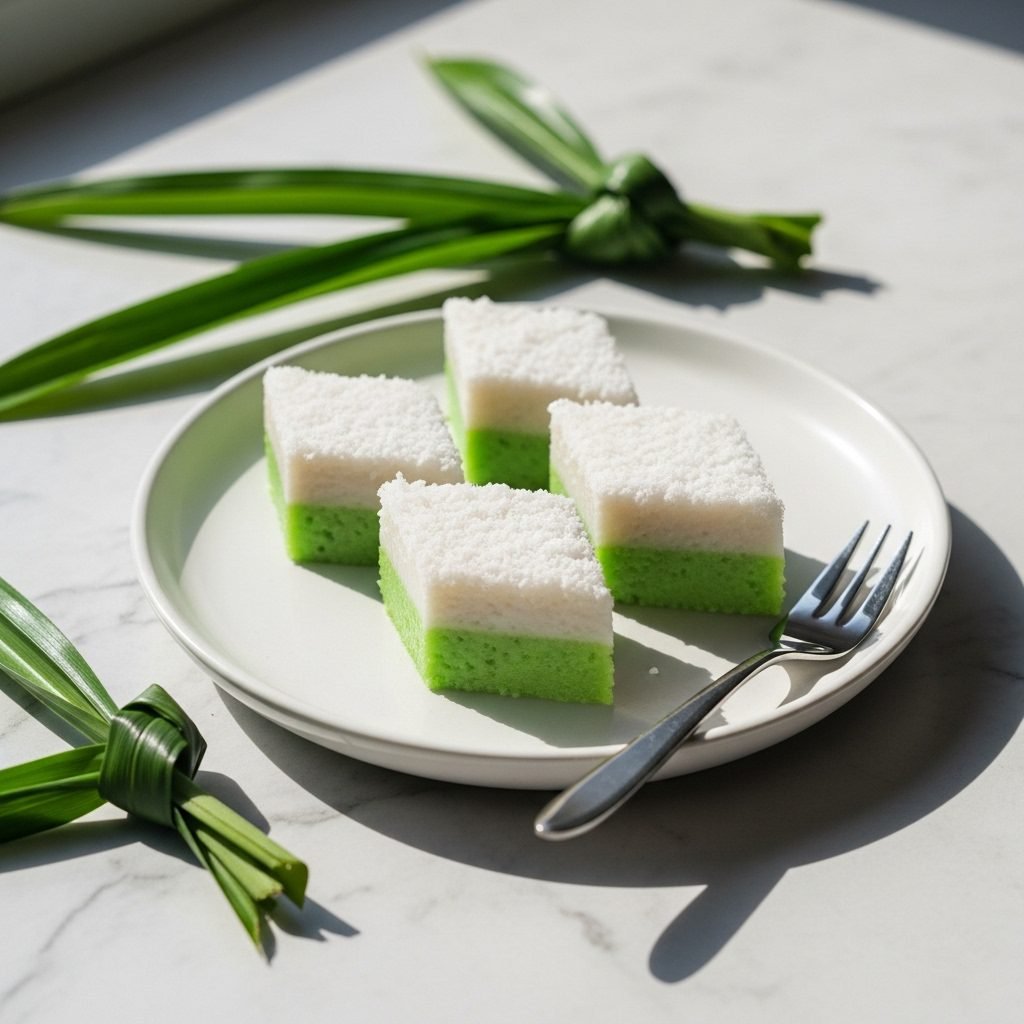
Silky Pandan Coconut Steamed Layer Cake (Kuih Talam)
Kuih Talam Recipe
Get ready to fall in love with this stunning Malaysian dessert! Kuih Talam features a dreamy, jiggly green layer bursting with fragrant pandan, topped with a creamy, slightly salty coconut layer. It’s a beautiful, naturally gluten-free treat that looks incredibly impressive but is surprisingly simple to make at home.
25 minutes
45 minutes
3 hours 10 minutes (includes cooling time)
16 small squares (from an 8×8 inch pan)
Dessert
Steaming
Malaysian
Gluten-Free, Vegan
Why You’ll Love This Recipe
- Salty-sweet coconut meets fragrant pandan
- Silky, smooth, and delightfully jiggly texture
- A stunning two-layer dessert that’s easy to master
- Naturally gluten-free and vegan-friendly
Equipment You’ll Need
- Steamer with a lid (or a large pot with a steaming rack)
- 8×8 inch square baking pan
- 2 medium mixing bowls
- Whisk
- Fine-mesh sieve
- Measuring cups and spoons
- Small saucepan
Ingredients
- For the Green Pandan Layer (Bottom):
- 1 cup rice flour
- 1/4 cup tapioca starch
- 3/4 cup granulated sugar
- 1/4 teaspoon salt
- 1 cup pandan juice (from 10-12 pandan leaves blended with 1 cup water, then strained)
- 1 1/2 cups water
- 1/4 teaspoon food-grade lye water (alkaline water), optional but recommended
- For the White Coconut Layer (Top):
- 1/2 cup rice flour
- 3 tablespoons tapioca starch
- 1 tablespoon granulated sugar
- 1 teaspoon salt
- 2 cups full-fat canned coconut milk
- For Greasing:
- 1 teaspoon neutral oil (like canola or vegetable oil)
Instructions
- Prepare your equipment: Fill your steamer with water and bring it to a rolling boil over medium-high heat. Lightly grease the bottom and sides of your 8×8 inch square pan with oil.
- Make the green batter: In a medium bowl, whisk together the rice flour, tapioca starch, sugar, and salt. Pour in the pandan juice, water, and optional lye water. Whisk until completely smooth and no lumps remain.
- Strain the green batter: Pour the mixture through a fine-mesh sieve into another bowl or a large measuring cup to ensure a silky-smooth consistency. Discard any lumps.
- Steam the first layer: Pour the strained green batter into the greased pan. Carefully place the pan into the preheated steamer. Cover the steamer lid with a kitchen towel to prevent condensation from dripping onto the cake. Steam for 20-25 minutes, or until the layer is firm to the touch.
- Make the white batter: While the green layer is steaming, prepare the top layer. In a medium bowl, whisk together the rice flour, tapioca starch, sugar, and salt.
- Heat the coconut milk: In a small saucepan, gently warm the coconut milk over low heat just until it’s lukewarm. Do not boil it. Pour the warm coconut milk into the dry ingredients and whisk until completely smooth.
- Strain the white batter: Just like the green layer, pour the white batter through a fine-mesh sieve to remove any lumps.
- Steam the second layer: Once the green layer is set, gently and slowly pour the white batter over it. You can pour it over the back of a spoon to soften the impact and prevent the layers from mixing. Cover and steam for another 20-25 minutes, or until the white layer is fully set and not wobbly.
- Cool completely: Carefully remove the pan from the steamer and let it cool on a wire rack to room temperature. This is crucial and will take at least 2-3 hours. Do not attempt to cut it while warm.
- Chill and slice: For the cleanest cuts, once at room temperature, you can chill the kuih in the refrigerator for 30 minutes. Use a plastic knife or a sharp metal knife lightly greased with oil to cut into squares or diamonds. Serve and enjoy!
Expert Cooking Tips
- Don’t skip the sieve! Straining both batters is the secret to an incredibly smooth, lump-free Kuih Talam.
- Wrap your steamer lid with a clean kitchen towel. This simple trick catches condensation and prevents water droplets from ruining the surface of your beautiful cake.
- Patience is a virtue, especially during cooling. Cutting into warm Kuih Talam will result in a goopy mess. It must be completely cool to set properly and slice cleanly.
- For ultra-clean cuts, wipe your knife clean between each slice. A plastic disposable knife works surprisingly well!
Substitutions and Variations
If you can’t find fresh pandan leaves, you can substitute the pandan juice and 1.5 cups of water with 2.5 cups of water mixed with 1 teaspoon of high-quality pandan extract. The traditional lye water gives the pandan layer a characteristic springy texture, but it can be omitted if you can’t find it; the resulting texture will just be a bit softer. Do not substitute the full-fat coconut milk, as it’s essential for the rich flavor and firm set of the top layer.
Common Mistakes to Avoid
The number one mistake is cutting the kuih before it has completely cooled. It needs several hours at room temperature to firm up. Another common issue is getting a lumpy texture; this is avoided by whisking well and, most importantly, straining both batters through a fine-mesh sieve. Finally, make sure your steamer water is at a rolling boil before you start and that you have enough water to last the entire steaming time to avoid opening the lid and disrupting the cooking process.
Serving Suggestions
Kuih Talam is a delight on its own, perfect as an afternoon snack with a cup of hot black coffee or jasmine tea to balance its sweetness. For a dessert platter, arrange the vibrant squares alongside fresh tropical fruits like mango or pineapple. It’s best served at room temperature or slightly chilled.
Storage and Reheating Tips
Store any leftovers in a single layer in an airtight container in the refrigerator for up to 3 days. The kuih will firm up when chilled, so for the best texture, let it sit at room temperature for about 20-30 minutes before serving.
Nutrition Facts (Estimated)
| Serving Size | 1 square |
| Calories | 120 kcal |
| Fat | 6 g |
| Saturated Fat | 5 g |
| Unsaturated Fat | 0.5 g |
| Trans Fat | 0 g |
| Cholesterol | 0 mg |
| Sodium | 90 mg |
| Carbohydrates | 15 g |
| Fiber | 1 g |
| Sugar | 10 g |
| Protein | 1 g |
Frequently Asked Questions
Why did my two layers separate after steaming?
Separation can happen if the green layer wasn’t steamed long enough to be fully set before adding the white layer. It can also occur if you pour the white batter too quickly. Pour it slowly and gently over the back of a spoon to diffuse the stream.
Can I use low-fat coconut milk for the top layer?
It’s strongly recommended to use full-fat, canned coconut milk. The fat content is crucial for achieving the creamy texture and ensuring the top layer sets properly. Low-fat milk will result in a watery and unset layer.
My kuih talam is too soft and didn’t set properly. What went wrong?
This is usually caused by one of two things: under-steaming or not cooling it long enough. Make sure each layer is steamed for the full time recommended until it’s firm. Most importantly, the cooling process is part of the ‘cooking’—it’s when the starches set and the kuih firms up completely.
How do I get a vibrant green color without food coloring?
The key is to use plenty of fresh, dark green pandan leaves. Use about 10-12 mature leaves for 1 cup of water when making your juice. Blend them thoroughly and let the mixture sit for a few minutes before straining to extract as much color and flavor as possible.
Conclusion
Making this gorgeous Kuih Talam from scratch is such a rewarding experience! The aroma of pandan and coconut filling your kitchen is simply divine, and the final result is a silky, satisfying dessert that will wow anyone who tries it. Give this recipe a go, and don’t forget to share your beautiful creations! Snap a photo and tag us on Pinterest and Instagram – we can’t wait to see them!