Those Famous Scorched-Top Tarts: A Surprisingly Doable Pastel de Nata Recipe
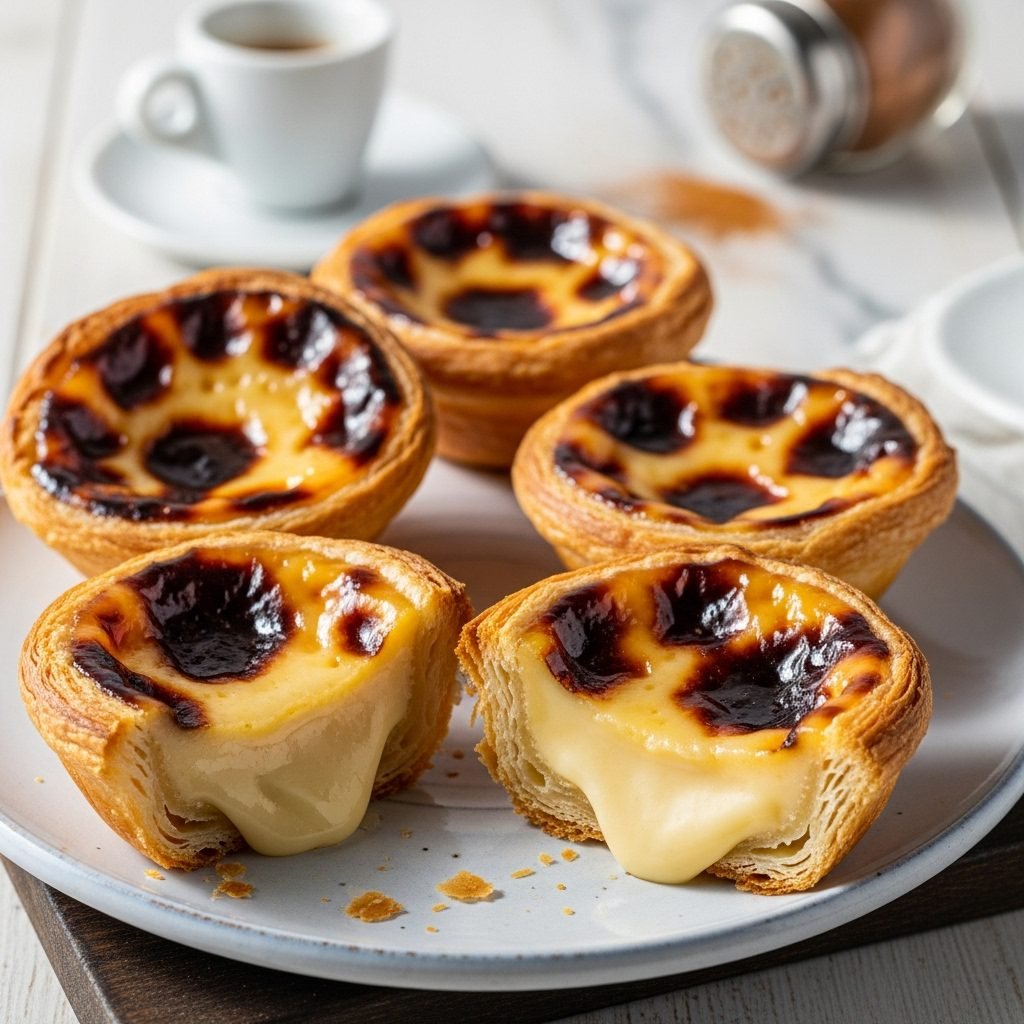
If you’ve ever had a true Pastel de Nata, you know the magic. You pick up the small, hefty-for-its-size tart. You bite through a crust that shatters into a thousand paper-thin, buttery layers. Then you hit the center: a pool of rich, sweet, barely-set custard that’s somehow both simple and luxurious.
And the top? That signature, rustic, scorched-black-in-spots, caramelized top. It’s a masterpiece.
These famous Portuguese custard tarts, born in Lisbon, look like something only a professional pastry chef with a specialty oven could create. They feel intimidating. But I’m here to tell you a secret: you can make these at home. And with one very smart, very acceptable shortcut, they’re not just doable, they’re fun.
The key is a blazing hot oven and a good-quality, store-bought, all-butter puff pastry. We’re skipping the hours of laminating dough from scratch (a project for another day!) and focusing on getting that flaky swirl and that creamy, blistered center.
Get ready. Your kitchen is about to smell like the best bakery in Portugal.
Why You’ll Be Making These on Repeat
- The Flavor: It’s a perfect balance. The buttery, slightly-salty, flaky pastry cuts through the sweet, rich, vanilla-and-cinnamon-kissed custard.
- The Texture: This is where it wins everything. The crunch of the many, many pastry layers followed by the silky, luscious, creamy (not stiff or jelly-like) filling is a top-tier dessert experience.
- Difficulty: I’ll call this an “ambitious beginner / easy-medium.” There are a few steps to the custard, but none are difficult. The pastry “hack” is what makes this accessible. The only real requirement is a very, very hot oven.
- That “Wow” Factor: When you pull these out of the oven, puffed up and beautifully blistered, you’ll feel like a baking champion. They are incredibly impressive.
What You’ll Need
This recipe uses a traditional method for the custard, which involves a sugar syrup and a milk base. It sounds fussy, but it’s the secret to a silky-smooth texture that doesn’t curdle.
For the Custard:
- 1 ¼ cups (250g) granulated sugar
- ½ cup (120ml) water
- 1 cinnamon stick
- 1 wide strip of lemon peel
- 1 ⅓ cups (320ml) whole milk
- ¼ cup (35g) all-purpose flour
- ¼ tsp salt
- 6 large egg yolks (yes, six! Save the whites for meringues)
- 1 tsp vanilla extract
For the Pastry Shells:
- 1 sheet (approx. 9-10 oz) all-butter puff pastry, thawed but kept cold
- A little all-purpose flour for dusting
Special Equipment:
- A standard 12-cup non-stick muffin tin
- A fine-mesh sieve (this is non-negotiable for a smooth custard)
Let’s Make Pastéis de Nata, Step-by-Step
Don’t be intimidated by the steps. Just read through them first, get your ingredients ready, and take it one part at a time.
First, Get Your Oven Blazing Hot Before you do anything else, preheat your oven to 500°F (260°C), or as high as it will go. You want it to be screaming hot. Place a rack in the upper third of the oven.
Part 1: Make the Stovetop Custard
- Make the Sugar Syrup: In a small saucepan, combine the granulated sugar, water, cinnamon stick, and lemon peel. Bring to a boil over medium heat, stirring just until the sugar dissolves. Let it boil (without stirring) for 2-3 minutes. Remove from the heat and let it steep while you do the next step.
- Make the Milk Base: In a separate, medium saucepan, pour in about 1 cup of the whole milk and set it over medium heat to warm up. In a separate bowl, whisk the remaining ⅓ cup of cold milk with the all-purpose flour and salt until it’s a completely smooth, lump-free slurry.
- Thicken the Milk: Once the milk on the stove is hot and steaming (not boiling), slowly pour in the flour-milk slurry while whisking constantly. Keep whisking over the heat. The mixture will thicken up quite suddenly, like a thin pudding. This only takes a minute or two. Once it’s thick, remove it from the heat.
- Combine: Remove the cinnamon stick and lemon peel from your sugar syrup. Now, in a very slow, steady stream, pour the hot sugar syrup into the thick milk base, whisking the whole time. The mixture will become very thin and smooth again. This is exactly what you want!
- Cool Slightly: Let this custard base cool down for 10-15 minutes. It should be warm, not scalding hot.
- Add the Yolks: In a medium bowl, lightly whisk your 6 egg yolks and the vanilla extract.
- Temper the Yolks: Very slowly (a tiny bit at a time at first), whisk about a cup of the warm custard base into the egg yolks. This gently warms them up. Once you’ve added about a cup, you can pour the egg yolk mixture back into the main pot of custard, whisking everything to combine.
- Strain! This is the secret to a silky custard. Pour the entire custard mixture through a fine-mesh sieve into a large liquid measuring cup (this makes pouring into the tins easier). Set it aside.
Part 2: Prepare the Pastry Shells
- Prep the Pastry: Lightly flour your counter. Unroll your thawed sheet of puff pastry. If it’s very thick, you can roll it slightly to an 11- or 12-inch square, but don’t roll it too thin.
- Roll the Log: Starting from the side closest to you, tightly roll the pastry into a log, like you’re making cinnamon rolls. Try to get it as tight as you can.
- Cut the Discs: Trim the two uneven ends off the log. Now, cut the log into 12 equal 1-inch pieces.
- Press into the Tin: Place one pastry disc, swirl-side-up, into each of the 12 muffin cups.
- The “Thumb Trick”: This is the fun part. Have a small bowl of cold water nearby. Dip your thumb into the water, then press it firmly into the center of the pastry swirl. Push the dough down to form a base and then up the sides of the muffin cup, all the way to the top edge. You’re essentially “smearing” the dough up the sides. The bottom should be relatively thin, and the sides a little thicker.
- Fill the Shells: Grab your strained custard. Give it a gentle stir. Fill each pastry cup about ¾ of the way full. Don’t go all the way to the top, as they will bubble.
Part 3: The Bake (This is Fast!)
- Bake Hot: Place the muffin tin on the upper-third rack in your preheated 500°F oven.
- Watch the Magic: Bake for 12 to 17 minutes. You’re looking for two things: the pastry edges should be a deep golden brown and puffed, and the tops of the custard should be beautifully blistered with dark brown or even black spots. The spots are required! That’s the signature look.
- Cool: Carefully remove the pan from the oven. Let the tarts cool in the pan on a wire rack for 10-15 minutes. They will be very puffed up, and they will deflate and sink in the middle. This is 100% normal and correct.
- Remove: Once you can handle the pan, use an offset spatula or a small knife to gently loosen and lift the tarts out onto the wire rack to finish cooling.
My Top Tips for Bakery-Worthy Tarts
- The Oven Must Be Hot: I know I’ve said it a lot, but this is the whole recipe. A 400°F oven will not work. It will just dry out the custard. You need 500°F or 550°F to simultaneously blast-cook the custard and puff the pastry, creating those blisters.
- Use All-Butter Puff Pastry: Please, if you can, find puff pastry made with all butter, not oil or shortening. The flavor is a million times better and it’s what gives that rich, bakery-case taste.
- The Wet Thumb Trick: Don’t skip dipping your thumb in cold water when you press the pastry. It stops the dough from sticking to your hand and lets you “smear” it up the sides properly.
- Don’t Fear the Spots: You are trying to get those dark, caramelized, “burnt” spots. That’s not a mistake, that’s the goal. It’s the flavor.
- Strain That Custard: Don’t be lazy and skip this. It takes 10 seconds and is the difference between a silky-smooth center and one with tiny, scrambled-egg specks.
A Few Swaps & Notes
- Gluten-Free: This works wonderfully with a sheet of store-bought gluten-free puff pastry! The custard is already naturally gluten-free (as it’s thickened with flour, not wheat).
- Dairy-Free: You can try this with a full-fat, high-quality oat milk or soy milk and a dairy-free puff pastry. The custard’s texture will be a little less rich, but it’s a good alternative.
- The Infusions: The cinnamon stick and lemon peel are classic. You can absolutely skip them and just use 2 teaspoons of vanilla extract for a pure, clean vanilla-egg flavor.
Common Pitfalls (And How to Fix Them)
- “My pastry is soggy, not flaky!”
- Problem: Your oven wasn’t hot enough. The pastry “fried” in its own butter instead of “exploding” with steam.
- Fix: Next time, hotter oven! Make sure it’s fully preheated for at least 30 minutes.
- “My tarts have no black spots!”
- Problem: Again, oven not hot enough. Or your rack was too low.
- Fix: 500°F+ and use the upper-third rack to get it close to the heat source.
- “My custard is lumpy!”
- Problem: You didn’t strain it, OR you added the egg yolks when the milk/syrup base was scalding hot, scrambling them on contact.
- Fix: Let the base cool for 10 minutes, temper the yolks, and always strain.
- “Why did my tarts sink in the middle?”
- Problem: This isn’t a problem!
- Fix: They are supposed to sink. A Pastel de Nata is not a cupcake. It puffs dramatically in the oven and then settles as it cools, leaving a creamy, sunken center. This is the correct and desired texture.
How to Serve Them (The Traditional Way)
These tarts are meant to be eaten warm, ideally on the day they are made. In Portugal, you’ll find shakers on the counter at every pasteleria.
- The most traditional way to serve them is with a generous dusting of ground cinnamon and/or powdered sugar.
- A tiny cup of strong espresso on the side is the perfect companion.
Storage and Reheating (A Hot Topic)
I’m going to be honest with you: a Pastel de Nata is a “day of” dessert. The magic is in the contrast of the crisp crust and soft center.
- Storage: If you have leftovers, store them in an airtight container at room temperature (if you’ll eat them within a day) or in the fridge for 2-3 days. The crust will go soft.
- Reheating (The Lifesaver!): You can bring them back to life! Place the soft tarts in a 400°F (200°C) oven or an air fryer for 3-5 minutes. The crust will crisp up beautifully and the center will get warm and lovely again. Do not microwave them.
Your Pastel de Nata Questions
- What’s the difference between this and a Chinese egg tart? They look similar, but they’re very different! Chinese egg tarts (dan tats) usually have a crust that is either a flaky, lard-based pastry or a crumbly shortcrust. The custard is also simpler, often just eggs, sugar, and evaporated milk, and it’s not caramelized on top.
- Can I make these in a mini-muffin tin? Yes! This is a great way to make a lot of tiny, bite-sized ones. Follow all the steps, but cut your log into 24 smaller discs. The baking time will be much shorter, probably 8-12 minutes, so watch them closely.
- Why six egg yolks? All those yolks are what make the custard so incredibly rich and yellow, with a texture that’s creamy, not firm.
A Little Piece of Lisbon, at Home
This is such a fun, rewarding bake. When you get the steps down, you’ll be amazed at what you can produce in your own kitchen. That moment you pull the pan out of the oven, with all the tarts puffed and blistered, is just the best.
I hope you’ll give these a try. They’re a true classic for a reason.
Recipe Summary
This recipe guides you through making authentic-tasting Pastéis de Nata (Portuguese Custard Tarts) using a smart shortcut: store-bought puff pastry. You’ll create a silky, stovetop custard by combining a sugar syrup and a milk-flour base with egg yolks, then strain it for smoothness. The pastry is rolled, cut, and pressed into a muffin tin, filled with the custard, and baked in a blazing-hot 500°F oven until the crust is shatteringly crisp and the top is famously caramelized and blistered.
Share Your Bake!
I would be so excited to see your tarts! If you make these, please tag me on social media [Your Social Handle Here] or leave a comment below. And if you loved them, I’d be so grateful if you’d Pin this recipe to share it!
Happy baking!