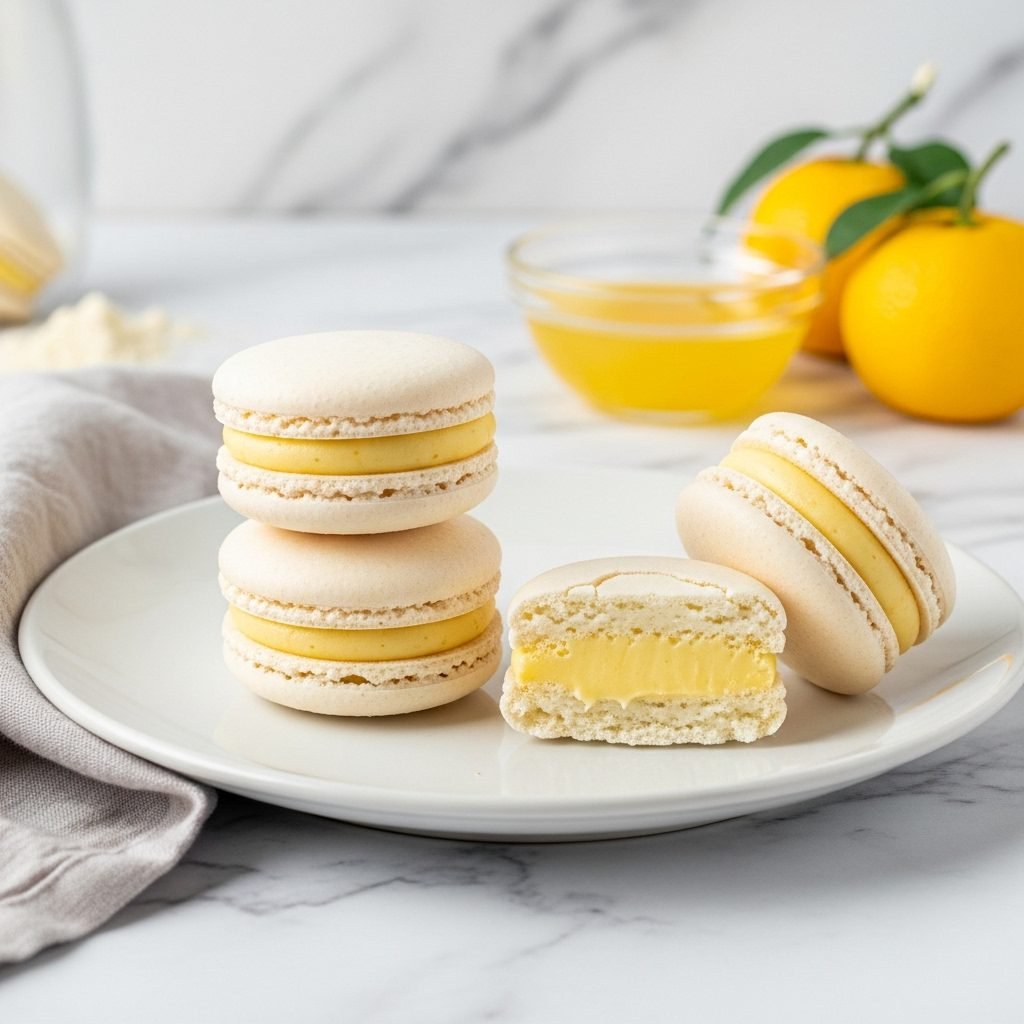
Bright & Chewy Yuzu Macarons (with a Zesty White Chocolate Ganache)
Hello, fellow bakers! Let’s talk about macarons. For so many of us, they’re that one baking project that feels just a little intimidating. We see them in Parisian bakeries, looking all dainty and uniform, and think, “There’s no way I can do that at home.”
I’m here to tell you that you absolutely can. And today, we’re not just making any macarons; we’re making my favorite ones: Yuzu Macarons.
If you’ve never had yuzu, you are in for such a treat. It’s a citrus fruit from East Asia, and its flavor is incredible—like a party where a lemon, a grapefruit, and a mandarin orange all showed up. It’s floral, it’s tart, and it’s unbelievably bright.
We’re pairing that zesty punch with a sweet, creamy white chocolate ganache, all sandwiched between two light, crisp, and chewy almond shells. The balance is just so good.
This recipe uses the Italian meringue method. Don’t let the name scare you! It just means we’re using a hot sugar syrup to make the meringue. I find this method so much more stable and reliable, especially if you live in a place with unpredictable humidity (like I do!). It gives you a much better chance of getting those coveted “feet”—the little ruffled edges at the bottom of the shell.
This is a recipe that asks for your attention, but it’s not “difficult” so much as it is “precise.” Follow the steps, trust the process, and get ready to impress yourself (and everyone you know).
Why You’ll Be Obsessed with This Recipe
- The Flavor: The yuzu is a total showstopper. It cuts through the sweetness of the meringue and white chocolate, creating a really sophisticated, vibrant, and refreshing cookie.
- The Texture: This is what macaron dreams are made of. You get the delicate snap of the outer shell, followed by a soft, slightly chewy almond center, and then the silky, rich ganache.
- The “Wow” Factor: Let’s be honest, they look amazing. The shells are a beautiful, natural, creamy-white, and that pop of pale yellow filling is so pretty. They are the star of any dessert table.
- The Guide: This isn’t just a list of ingredients. I’m walking you through every single part, especially the tricky bits (looking at you, macaronage), so you’ll feel confident from start to finish.
What You’ll Need for These Yuzu Beauties
Grab your kitchen scale for this one! Macarons are a science, and the most common reason they fail is an improper ratio of ingredients. Using cups can be inconsistent, but I’ve provided the most accurate cup-based measurements I can. If you have a scale, now is the time to use it.
For the Yuzu White Chocolate Ganache (Make this first!)
- 4 oz good-quality white chocolate, finely chopped (not chips!)
- 1/4 cup heavy cream
- 3 tbsp bottled yuzu juice (This is easiest to find. Look in Asian markets or online.)
- 1 tbsp unsalted butter, softened
For the Macaron Shells (Italian Meringue Method)
- 1 1/4 cups almond flour, finely ground
- 1 1/4 cups powdered sugar
- 1/2 cup egg whites (from about 4-5 large eggs), divided
- A pinch of cream of tartar
- 3/4 cup granulated sugar
- 1/4 cup water
Let’s Make Yuzu Macarons, Step by Step
This is a journey, so put on some good music, clear your counters, and let’s get started.
Part 1: The Yuzu Ganache (Make This First!)
The ganache needs time to chill and set up, so we make it first.
- Chop the Chocolate: Finely chop your white chocolate bar and place it in a medium-sized, heat-safe bowl. The smaller the pieces, the faster and more evenly it will melt.
- Heat the Cream: Pour the heavy cream into a small saucepan and heat it over medium-low heat until it’s just simmering around the edges. Don’t let it come to a full, rolling boil.
- Melt Together: Pour the hot cream directly over the chopped white chocolate. Don’t stir! Just let it sit for 5 minutes. The residual heat will melt the chocolate.
- Whisk: After 5 minutes, add the softened butter and start whisking from the very center of the bowl, moving in small circles. The mixture will start to come together (emulsify). Keep whisking, moving your circles outward, until the ganache is completely smooth and glossy.
- Add the Yuzu: Pour in the yuzu juice and whisk until it’s fully combined.
- Chill: Press a piece of plastic wrap directly onto the surface of the ganache (this prevents a skin from forming). Place it in the refrigerator to chill for at least 1-2 hours, or until it’s firm enough to pipe (like a thick, spreadable frosting).
Part 2: The Macaron Shells
Okay, deep breath. You can do this.
- Prep Your Station: Line two large baking sheets with parchment paper or silicone mats. If you’re using parchment, you can trace 1.5-inch circles on the underside as a guide (I love using a small biscuit cutter or a bottle cap). Fit a large piping bag with a medium round tip (like a Wilton 12).
- Sift, Sift, Sift: In a large bowl, add your almond flour and powdered sugar. Whisk them together, then sift them through a fine-mesh sieve. Do not skip this step. This is the secret to a smooth, glossy macaron top. If you have some larger almond bits left in the sieve, don’t force them through; just discard them.
- Make the Almond Slurry: Add half of your egg whites (1/4 cup) to the sifted almond/sugar mixture. Don’t add them all! Mix this with a spatula until it forms a very thick, stiff paste. It will feel wrong, but it’s right. Trust the process. Set this bowl aside.
- Start the Meringue: Place the other half of your egg whites (1/4 cup) and the pinch of cream of tartar into the clean, dry bowl of a stand mixer fitted with the whisk attachment.
- Make the Sugar Syrup: In a small, heavy-bottomed saucepan, combine the granulated sugar and water. Stir just to combine. Clip a candy thermometer to the side of the pan. Heat over medium-high heat, without stirring, until the syrup reaches 244°F (the “soft-ball stage”).
- Whip the Whites: When the sugar syrup hits about 230°F, turn your stand mixer on to medium-low speed and whip the egg whites until they are foamy and at soft peaks (the peak just flops over). You’re trying to time this so your whites are ready right when your syrup hits 244°F.
- Combine Syrup and Whites: As soon as the syrup reaches 244°F, remove it from the heat. Turn the mixer speed up to medium. Very slowly and very carefully, pour the hot syrup in a thin, steady stream down the side of the mixing bowl. Avoid hitting the whisk, or the hot syrup will spatter.
- Whip Until Stiff: Once all the syrup is added, turn the mixer up to medium-high. Let it whip for 8-12 minutes. You’re waiting for the meringue to become stiff, incredibly glossy, and for the outside of the bowl to cool down to just lukewarm. When you lift the whisk, the peak should be stiff and stay put.
Part 3: The Macaronage (This is the most important part!)
Macaronage is the French term for folding the meringue into the almond paste. This is where you develop the final texture.
- First Fold: Add about 1/3 of your glossy Italian meringue to the bowl with the thick almond paste. Fold it in aggressively with your spatula. You’re just trying to lighten up the paste, so don’t be gentle.
- Second & Third Folds: Add the remaining meringue in two more batches. Now, you fold gently. Use your spatula to scrape around the side of the bowl and then cut through the middle. Turn the bowl a quarter-turn and repeat.
- The “Lava” Test: You are looking for a very specific consistency. The batter should be smooth, glossy, and “flow like slow-moving lava.” The final test: lift your spatula and drizzle the batter. It should fall in a continuous, thick ribbon, and you should be able to draw a “figure 8” with it without the ribbon breaking. If the ribbon breaks, fold a few more times and test again. Be careful not to over-mix! If you go too far, the batter will be runny, and your macarons will spread and be flat. It’s always better to be slightly under-mixed than over-mixed.
- Pipe Your Shells: Transfer the batter to your prepared piping bag. Hold the bag straight up (perpendicular) about a half-inch above the baking sheet. Squeeze the bag without moving it, letting the batter fill your traced circle. Stop squeezing and “swirl” the tip away quickly to finish.
- Rap the Pans: Once you’ve piped all your shells, pick up the baking sheet and rap it hard on the counter 3-4 times. This is loud, but it’s essential! It forces any large air bubbles to the surface, which prevents your shells from cracking in the oven. You’ll see little bubbles pop. You can use a toothpick to pop any stubborn ones.
- Rest the Shells: This is the second non-negotiable step. Leave the baking sheets on your counter at room temperature for 30-60 minutes (it depends on your humidity). You’re waiting for the shells to form a “skin.” You should be able to gently touch the top of a macaron, and your finger should come away clean. The shell will feel dry and matte, not sticky.
- Bake: Preheat your oven to 300°F. Place one baking sheet at a time on the center rack. Bake for 15-18 minutes. To check for doneness, gently nudge the top of a shell. If it slides around or “wobbles” on its feet, it needs more time. If it feels firm, it’s done.
- Cool Completely: Let the macarons cool completely on the baking sheet before you try to remove them. If you try to peel them off while warm, they will stick and break. Be patient!
Part 4: Assemble Your Masterpieces
- Match the Shells: Once cool, gently peel the shells off the parchment. Find “partner” shells that are a similar size and shape.
- Fill the Shells: Transfer your chilled, firm yuzu ganache to a piping bag. Pipe a generous dollop of ganache onto the flat side of one macaron shell.
- Sandwich: Gently press the other macaron shell on top, twisting slightly, until the ganache comes just to the edge.
- MATURE THEM. This is the final secret! Place the assembled macarons in an airtight container and put them in the refrigerator for 24-48 hours. This is called “maturing.” It’s not optional! This step allows the shells to soften just a bit by absorbing moisture from the ganache, melding the flavors and creating that signature chewy texture.
My Top Tips for Macaron Success
- Humidity is the Enemy: I mean it. If it’s a very rainy or humid day, your shells will struggle to form a skin and may not bake properly. Try to bake on a dry day if you can.
- Know Your Oven: Most ovens are liars. An oven thermometer is your best friend. If your oven runs hot, your shells might crack or brown. If it runs cool, they might not rise. 300°F is a great starting point, but you may need to adjust by 10-15 degrees.
- Clean, Clean, Clean: Any speck of grease or fat in your meringue bowl or on your whisk will prevent your egg whites from whipping up properly. Wipe your bowl and whisk with a little white vinegar or lemon juice to be extra sure.
- Don’t Change the Ingredients: Macarons are not the time to get creative with substitutions. Don’t try to reduce the sugar (it’s essential for the structure) or swap the almond flour.
Ingredient Swaps & Variations
- For the Yuzu: If you absolutely cannot find yuzu juice, you can get a similar vibe by using Meyer lemon juice (which is sweeter and more floral than regular lemon) or a mix of 2 tablespoons of regular lemon juice and 1 tablespoon of grapefruit juice.
- For the Color: I love the natural, creamy white, but you can absolutely color your shells! Add a tiny drop of yellow gel food coloring to your Italian meringue after it has finished whipping (right before you start the macaronage).
- Gluten-Free: Great news! This recipe is naturally gluten-free. Just double-check that your powdered sugar and almond flour are certified GF if you’re baking for someone with a severe allergy.
Common Macaron Pitfalls (and How to Fix Them)
- My Shells are Cracked: This is heartbreaking! It usually means your oven was too hot, or you didn’t rap the pans hard enough to get the air out, OR you didn’t let them rest long enough to form a skin.
- My Shells are Hollow: The shell top is separated from the “foot.” This can be from over-whipping your meringue (a common issue with the French method, less so with Italian) or under-baking them.
- My Shells Have No “Feet”: This is often a sign of an under-whipped meringue (it wasn’t stiff enough) or, more likely, you over-mixed your batter during the macaronage. It was too runny.
- My Shells are Lumpy: You didn’t sift your almond flour and powdered sugar!
- My Shells Spread Out and are Flat: You definitely over-mixed the batter. Your “lava” was more like “water.”
Don’t be discouraged if your first batch has some of these issues. My first batch was a disaster! Just think of them as “baker’s treats” and try to figure out what to adjust for next time.
How to Serve Your Beautiful Macarons
After they’ve matured in the fridge, take them out about 20 minutes before you plan to serve them to let them come to room temperature. This is when their flavor and texture are at their best.
Arrange them on a pretty plate, pair them with a cup of green tea or coffee, and get ready for the compliments. They are perfect for a party, a high tea, a baby shower, or just as a special treat for yourself.
Storing Your Macarons (The Right Way)
As mentioned, storage is a key part of the recipe (the “maturing” step).
- In the Fridge: Assembled macarons should be stored in an airtight container in the refrigerator. They will last for up to 5 days.
- In the Freezer: Yes, they freeze beautifully! Place them in a single layer in an airtight container. They’ll last in the freezer for up to 3 months. Let them thaw in the fridge or on the counter for 30 minutes before serving.
Your Yuzu Macaron Questions, Answered
What exactly is yuzu? It’s a citrus fruit popular in Japan, Korea, and China. It’s bumpy, yellow, and looks a bit like a small grapefruit. The flavor is its real superpower—intensely aromatic, tart, and complex.
Where can I buy yuzu juice? Your best bet is a local Asian market or specialty grocery store. It’s also widely available online from retailers like Amazon. You’ll almost always find it bottled, which is perfectly fine for this recipe.
Why the Italian meringue method? It seems complicated. It has an extra step with the hot syrup, but that syrup cooks the egg whites, making the meringue incredibly strong and stable. It’s much less likely to fail due to humidity or slight over-mixing, which is why I love it for beginners.
Can I use almond meal instead of almond flour? They’re similar, but for macarons, you need “finely ground almond flour.” Almond meal is often coarser and may still have the skins, which will give you a lumpy, bumpy macaron.
You Did It!
I know that was a lot of information, but I wanted to give you every single tip I have to help you nail this recipe. Making macarons is a true labor of love, and when you pull that first tray of perfect, footed shells from the oven, the feeling is just unbeatable.
Whether this is your first time or your fiftieth, I hope you love the bright, sunny flavor of these yuzu macarons as much as I do.
Quick Recipe Summary
These sophisticated yuzu macarons feature crisp, chewy almond-flour shells made using a stable Italian meringue. The shells are filled with a bright, zesty ganache made from high-quality white chocolate and tangy yuzu juice. After assembling, the macarons are “matured” in the refrigerator for 24 hours to develop their signature chewy texture and meld their flavors.